

Starting a coaching business: the checklist
Fourteen things come up when people set out to do this. We measured how often each one gets asked about, then sorted them by something different: whether it actually stops money reaching you. Seven do. Seven do not.
Both lists are below, with the argument on each side and what each one costs. We are not going to tell you which way to go on any of them.

Until these are done there is a specific reason money cannot reach you. Each one is a yes or no question.
Some coaches call this procrastination. Others call it going to market. We are not judging either way. None of them is what stands between you and a first payment.
Measured in September 2026, United States, English. Autocomplete moves, so we re-measure whenever this page is updated.
Can you name who you help, and what changes for them?
Fewer people ask about this than almost anything else on the page, and it still comes first, because everything downstream is a sentence you cannot write without it: your price, your booking page, the message you send to ten people.
Paste into Claude or ChatGPT. Fill the brackets.
I have spent [N] years doing [WHAT]. People have come to me for help with [WHAT, INFORMALLY]. Propose five coaching niches for me. Write each one as a single sentence: who the person is, and what is different for them afterwards. For each, say who is already paying somebody for this today. Do not pick one for me.
Check before you use it: Any niche it names that you would not say out loud to a stranger is the wrong niche, however good it sounds.
Do you know what you sell, and what it costs?
The second most asked-about thing in the whole set, and the one people circle for longest. A number you have not written down is a number you will discount the first time somebody hesitates.
Rates as published across the market, checked in September 2026. The sources disagree at the edges, which is itself the answer: there is no going rate.
Paste into Claude or ChatGPT. Fill the brackets.
I want to earn [AMOUNT] a year before tax. I can hold [N] client hours a week and I will work [N] weeks. Show me, with the arithmetic written out, what I have to charge per session. Then show it again assuming only 70% of those hours ever sell. Do not advise me on what to charge.
Check before you use it: Do one row by hand. Assistants are confident about multiplication and not always right.
Are you allowed to trade, and covered if it goes wrong?
The fourth biggest question cluster here, and the one where the answer genuinely changes depending on where you are standing. Everything below is the shape of the decision, not the decision.
Paste into Claude or ChatGPT. Fill the brackets.
I am setting up as a coach in [CITY, COUNTRY OR US STATE]. Write me a list of questions to take to an accountant, covering: what has to be registered before I take a first payment, sole trader against a company for my situation, what to set aside as money comes in, and how a package paid in one month but delivered over six is treated. Do not answer them. I want the question list only.
Check before you use it: If it answers any of them with a number, ignore that part. Nothing on this page and nothing from an assistant is tax advice.
Can the money actually reach you?
An hour of setup that decides whether a client who said yes has actually paid. It is the least discussed of the seven and the quickest to do.
Paste into Claude or ChatGPT. Fill the brackets.
Write the payment terms for my coaching practice as three short lines a client will actually read: when payment is due, what happens if a session is missed, and what happens to an unused package. My terms are [YOUR TERMS]. Plain language, no legal phrasing, no clauses I did not give you.
Check before you use it: If it invented a notice period or a refund rule you did not type, delete it. Those two are decisions, not defaults.
Is what you promised written down?
The quietest row on the chart and one of the seven that blocks you. Almost nobody searches for this until the week they wish they had.
Paste into Claude or ChatGPT. Fill the brackets.
Draft the clauses for a coaching agreement from my answers. Sessions: [N] over [WINDOW]. Price: [PRICE], due [WHEN]. Cancellation: [HOURS] notice, otherwise [WHAT HAPPENS]. Unused sessions: [WHAT HAPPENS]. Write plain English a client reads once and understands. At the end, list every situation my answers do not cover.
Check before you use it: That last list. It usually finds the case you had not thought about, illness being the common one, and that is a decision for you rather than for the assistant.
Can somebody book you without five emails?
This is also where a domain and a hello@ address live. One afternoon, about ten dollars a year, and not a milestone. It is the lowest-drama gate on the page and the one people turn into a month of work.
Paste into Claude or ChatGPT. Fill the brackets.
Write the About section for my coaching booking page. I help [WHO] with [WHAT]. A first session with me looks like [WHAT HAPPENS]. My background is [BACKGROUND]. Under 120 words, second person, no career chronology. Do not add any credential, client number or specialism I did not give you.
Check before you use it: That it has not handed you a credential or a client count you never typed. Delete anything you cannot prove.
Have you asked ten people?
The third most asked-about thing here and the last gate, because the other six exist to make this one possible. Nothing before it counts until somebody says yes.
Paste into Claude or ChatGPT. Fill the brackets.
Help me write one message to send to ten people who already know me. I help [WHO] with [WHAT]. I am [STARTING / EXPANDING] and I am looking for [N] clients. It should be short, sound like a person and not a campaign, make it easy to say no, and ask them to think of somebody rather than to hire me themselves. Give me one version, not three.
Check before you use it: Read it as if it arrived from a friend. If it reads like a newsletter, it will be treated like one.
Real work. Not what is stopping you.
Every one of these is defended seriously by somebody who coaches for a living, and dismissed just as seriously by somebody else. We are not going to settle that for you. What we will say is that none of them is the reason money has not arrived yet.

The single most asked-about thing on this page, and the one with the least settled answer. The International Coaching Federation runs a three-level credential requiring training hours, coached hours, mentor coaching and an exam, and argues that this is what makes a claim to competence checkable by a buyer who cannot otherwise tell. In most countries the industry is unregulated and nothing is formally required in order to take a client. On the main coaching subreddit, a thread of forty-four replies asks whether certification is needed; the top answer, from a coach of five years, is that one person has ever asked where she trained. Corporate and EAP buyers are where it stops being optional.
Marketers point at AI search and say a site is how you get found now. Working coaches keep posting that their first clients came from people who already knew them. Both are describing a different month of the same business.
Asked about roughly as often as taking payment is, which is worth sitting with. The case for is that people buy somebody they can picture. The case against is that nobody has ever reported losing a client over the absence of a logo.
On the main coaching subreddit, eighty replies to the question of whether social media is necessary to start. The top answer reports zero clients from it, after trying hardest at the beginning. Plenty of coaches underneath disagree, and the marketers disagree harder.
Asked about as often as marketing is. The case for is real: the coaches who skip it tend to rewrite their offer three times. The counter-case is equally real, and is usually made by coaches who have watched somebody spend a fortnight on wording rather than sending a message.
Being coached yourself, or taking your cases to somebody senior. The ICF builds it into credentialing, and it is asked about more often than registering a business is. Nobody claims it is what wins the first client.
A peer group and a membership. The argument for is isolation, the most commonly reported problem in solo practice, and referrals that come from other coaches. The argument against is that both arrive faster once you have clients to talk about.
What it costs to open
Start from one of the two positions coaches argue between, then switch individual lines on and off. Gate items are the seven that stop you being paid. Everything below the rule is the other seven.
The gap between the two totals is the easy part to see. What it buys is the part worth deciding on: Lean while a first paying customer is still weeks away and every dollar is a decision you make twice, Proper once your mail and your calendar have to work from the first week. Whichever you start on, the domain does not change when you move, so it is not a decision you are stuck with.
- $0one off
- $200a year
- $0one off
- $10a year
- $0a year
- $0a year
- $197one off
- $0one off
- $0one off
- $0a year
- $100.80a year
Published list prices in USD, checked in September 2026. Registration and insurance vary widely by country and by US state, so treat both as the shape of the cost rather than as your quote. Certification shows the floor of its range; accredited programs run well above it. Taking payment costs nothing to set up and is charged as a fee per transaction, so it has no line here.
Gate 6 is the one we can just hand you.
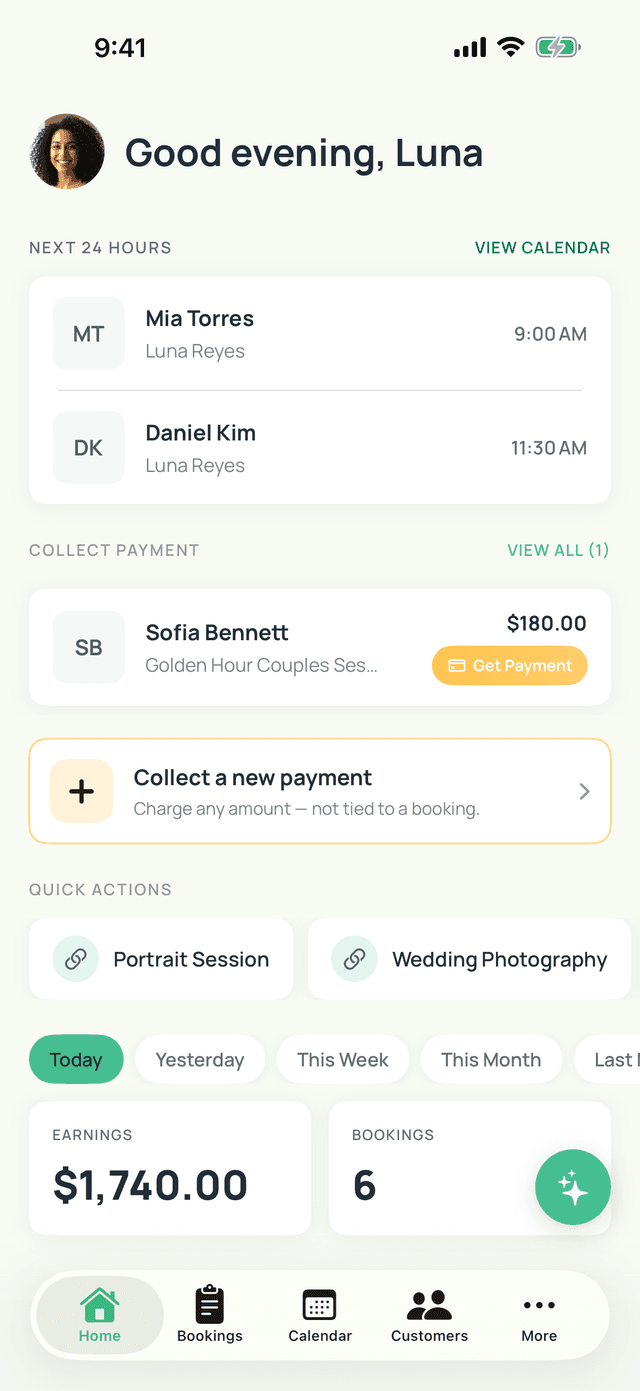
A booking page on your own domain, payment in the same step, and a free plan that takes the first hundred bookings without asking for a card.
- Your booking page, on your own domain or ours
- Card payment in the same step as the booking
- Single sessions, packages, and recurring slots
- Runs from your iPhone or your laptop


Nothing here is legal, tax or financial advice. Registration, insurance and whether coaching is regulated all change with where you live, and the only reliable answer comes from somebody who knows your jurisdiction.