

How to start a reiki business
Reiki turns into money two ways. You sit with a client, or you teach somebody to do it, and your first payment can arrive from either one. Both run on the same machinery underneath: a date, a price, a form, a calendar, somebody who has to be able to find you and pay you.
Fourteen things come up when people set out to start a reiki business. We measured how often each one gets asked about, then sorted them by something different: whether it actually stops money reaching you. Seven do. Seven can wait, whatever you have been told. Then we measured a fifteenth that nobody asks about at all, and left it on the chart as a control. Both lists are here, with the argument on each side and what each one costs.

Until these are done there is a specific reason the money cannot reach you, whether that money is a session fee or a seat on a class. Each one is a yes or no question.
Some people call this procrastination. Others call it going to market. We try not to judge either way. None of them is what is stopping the money.
Measured in September 2026, United States, English. Autocomplete moves, so we re-measure whenever this page is updated.
What are you attuned to, and what does that let you sell?
The gate you cannot talk your way around, because you can only pass on what you have been given. Level 1 opens hands-on work with other people, Level 2 opens distance work and the symbols, and Master is what lets you teach and attune somebody else. Your level decides more than your service list. It decides which of the two businesses is open to you, and at Level 1 only one side of the fork below is open at all. Both are available in the end. This is about which one you start with.
Paste into Claude or ChatGPT. Fill the brackets.
I am attuned to Reiki [LEVEL] and I took it [WHEN]. I want to work [IN THE ROOM / ONLINE / BOTH]. List the services I can honestly offer at this level, and separately the ones I cannot offer until I go up a level. For each service write the name a client would recognize and one sentence saying what happens in it. Do not describe a benefit or an outcome, and do not name a single condition.
Check before you use it: Anything it says the session will do for somebody, delete. What you are selling is time and attention, and that is a description you can stand behind.
Do you have a price, or do you decide in the room?
Two price ladders run side by side in this trade, and the second one is the first one read backwards: the numbers you paid to learn are the numbers you charge to teach. Before you pick any number, know what you are up against. Free online reiki courses exist and are searched for in volume, so anybody selling a class is being compared against a floor of zero. You do not have to match it. What a paid seat buys that a free course does not is a sentence your page has to be able to write.
Prices as published across the market, checked in September 2026. They disagree at the edges, and the spread is the answer: there is no going rate, only what your area carries and what you can say without flinching.
Paste into Claude or ChatGPT. Fill the brackets.
I charge [PRICE] for a [LENGTH] session and I can hold [N] sessions a week. I also want to run a Level 1 class for [N] students at [PRICE] a seat, [N] times a year. Show me, with the arithmetic written out, what a year looks like three ways: sessions only, classes only, and both. Then show the third one again with half the seats sold and a quarter of the session hours empty. Do not tell me what to charge.
Check before you use it: Check one line with a calculator. Arithmetic is where these tools sound most certain and are least reliable.
Are you allowed to do this where you live?
This is the gate that changes completely depending on where you are standing, and where most of this page has to stop at the shape of the answer. Two separate authorities are in play. Touching people is regulated by the board that handles massage and bodywork. Selling training that leads to a credential can fall under the body that licenses private career schools, a different office in a different building. The fork below settles the first question and leaves the second one open either way.
Paste into Claude or ChatGPT. Fill the brackets.
I want to practice reiki in [CITY, US STATE OR COUNTRY]. I [WILL / WILL NOT] make physical contact with clients, and I [DO / DO NOT] intend to teach certification classes. Write me two separate lists of questions: one for the board that licenses massage and bodywork where I live, and one for the department that licenses private or career schools. Do not answer them. I want the question lists only.
Check before you use it: If it answers one of them with a yes, a no or a number, ignore that part. Those two answers come from two different offices, and neither of those offices is an assistant.
Can the money actually reach you?
Near the bottom of the chart, and an hour of setup decides whether somebody who said yes has actually paid. A class seat is nearly always paid up front, because you are holding a seat, you have committed to a date and often to a room, and a chair nobody sat in is a loss you carry. A session frequently is not, which is why the fork below is a decision about sessions.
Paste into Claude or ChatGPT. Fill the brackets.
Write the payment terms for my reiki practice as four short lines a client reads once and understands: when payment is due for a session, when it is due for a class seat, what happens if somebody cancels, and what happens if a class does not run. My terms are [YOUR TERMS]. Plain language, no legal phrasing, no clauses I did not give you.
Check before you use it: A notice period or a refund rule you did not type is one it invented. Both of those are decisions, and both of them are yours.
Is what you promise written down, and is it claimable?
One of the busiest rows on this chart, which is unusual: paperwork is normally what nobody asks about until the week they wish they had. Reiki carries a second problem on top of the ordinary one. Treat, cure and heal are the words that attract a regulator, and they turn up in your own writing without being invited. And a course needs terms a session does not: attendance, refunds, your lineage, and above all what the certificate does not entitle the student to.
Paste into Claude or ChatGPT. Fill the brackets.
Draft an intake and consent form for reiki sessions from my answers. Session length: [LENGTH]. Physical contact: [HANDS ON / HANDS OFF / THE CLIENT CHOOSES]. What I ask about beforehand: [WHAT]. Describe what the session is and what it is not, in plain English a person reads once. Do not use the words treat, cure, heal or diagnose, and do not name a single condition. At the end, list every situation my answers do not cover.
Check before you use it: Search the draft for treat, cure, heal and diagnose before it goes anywhere near a client. Those four words are the difference between a description and a claim.
Can somebody book you without three messages?
A session is one slot for one person. A class is one date with a number of seats on it. Both are bookings, which is why this is a single job, and the gate where the two businesses stop being different at all. Both doors below can be open at once. The choice is which one is the front door. The questions underneath are your clients' questions, not yours. Answer them on the page and people stop messaging you to find out.
Paste into Claude or ChatGPT. Fill the brackets.
Write the service list for my reiki booking page. I offer [SERVICES] at [PRICES], each lasting [LENGTH], [IN PERSON / ONLINE]. I also teach [CLASS] with [N] seats on [DATE]. For each one, write a title and two sentences: what happens in it, and who it suits. Somewhere on the page, answer these four: how long it takes, what to wear, whether I make physical contact, and what happens afterward. Under 400 words, no claims about outcomes.
Check before you use it: Read it as somebody who has never had a session. If they would still have to message you to find out how long it takes, the page is not finished.
Do the first ten come from your own asking, or somebody else's footfall?
The quietest row on the chart, and the last gate, because the other six exist to make this one possible. Nothing before it counts until somebody says yes. If you intend to teach, this is also where the two businesses meet: a first class is nearly always filled from a client list, so the people you see this year are the people sitting in the room next year.
Paste into Claude or ChatGPT. Fill the brackets.
Help me write one message to ten people who already know me. I offer [WHAT] in [WHERE] and I am looking for [N] first clients. I am also [TEACHING / NOT TEACHING] a class, [WHEN]. Keep it human, keep it short, make it easy to say no, and ask them to think of somebody they know. Give me one version, not three.
Check before you use it: Read it back as if a friend had sent it to you. Whatever sounds like marketing is what stops it being answered.
Worth doing. Not what is stopping you.
Each of these is worth doing, and somebody who does this for a living will tell you it is essential. Somebody else, just as experienced, will call it what people do instead of asking ten people. None of them is the reason the money has not arrived yet.

Tied for the busiest row in this list at twenty-eight, usually taken six to twelve months after Level 2. It belongs here only if you intend to take clients: Level 1 already lets you work hands-on, and somebody booking a session is rarely asking what level you hold. If you intend to teach, it is not on this list at all. It is gate one: teaching reiki runs on the Master attunement, because that is what lets you attune somebody else, and without it there is no second business to run.
Twenty on the chart. A room at home, a table you carry to people, a space rented by the hour, a hall rented for the day of a class. All four are real answers, and every one is easier to pay for once somebody has paid you. The room is a consequence of clients, not a condition of them.
Twenty-five on the chart, one of the highest rows here, and it is not the part anybody is deciding on when they book. It is enjoyable work that feels like progress and produces something you can show people, which is exactly what makes it so good at absorbing two weeks.
The table has a real floor under it, and even that has a second-hand version. The rest is atmosphere, and atmosphere is something you build over years out of what you notice people respond to. A candle and a folded blanket will hold a first session.
Thirteen on the chart, level with taking payment. Posting is a job in its own right, and it is a slow one: it pays back over months if you keep at it, and not at all if you do it for three weeks. It is a legitimate channel, and it is not what produces a first booking.
A peer group, a directory listing, and somewhere to ask the question you do not want to ask a client. Reiki shares and community sit near the top of the chart at twenty-eight, and that is a genuine thing this trade offers that most do not. Real value, no urgency, and both arrive faster once you have clients to talk about.
Crystal, sound, chakra work. Stacking a second modality before the first one has a paying client is the classic stall, because learning feels like progress and asking feels like risk. The tell is simple: if you are booking a course this month and you have not yet asked ten people about the thing you are already qualified to do, the course is not the bottleneck.
What it costs to open
Start from the way you intend to work, then switch individual lines on and off. Every line is a range rather than a price, because not one of these costs the same thing in two places. Gate items are the seven that stop you being paid. Everything below the rule is the other seven.
Two businesses, three ways to open one, and a single identical bill to keep the doors open: $106 to $303 a year, whichever way you go. Insurance, a domain and a booking page do not care which one you chose. What separates them is the training ladder, and it runs in the direction most people do not expect. Working in the room opens cheapest, $256 to $553, because hands-on runs on Level 1. The ladder charges you for distance, not for contact. Online sessions need Level 2, so they open at $531 to $878, and teaching opens highest by a long way at $1,031 to $2,678, because nobody attunes a student without the Master level. One caveat outweighs all of those figures: the bodywork credential line shows zero only because there is no single number to show, and in Florida or Texas, where this work requires a massage therapy license, that one line could be larger than everything else on this page put together.
- $150–$250one off
- $275–$325one off
- $96–$185a year
- $0one off
- $0one off
- $10a year
- $0–$108a year
- $0one off
- $0one off
- $500–$1,800one off
- $0one off
Published prices in USD, checked in September 2026. Training, insurance and licensing all move with where you are, so no line here is your quote, only the shape of a cost. The lines showing zero have no single number to show: a form you adapt yourself, a credential only some states ask for, a room priced by your own town, a table you may already own. They are listed so you do not forget them, not because they are free.
Gate 6 is the one we can just hand you.
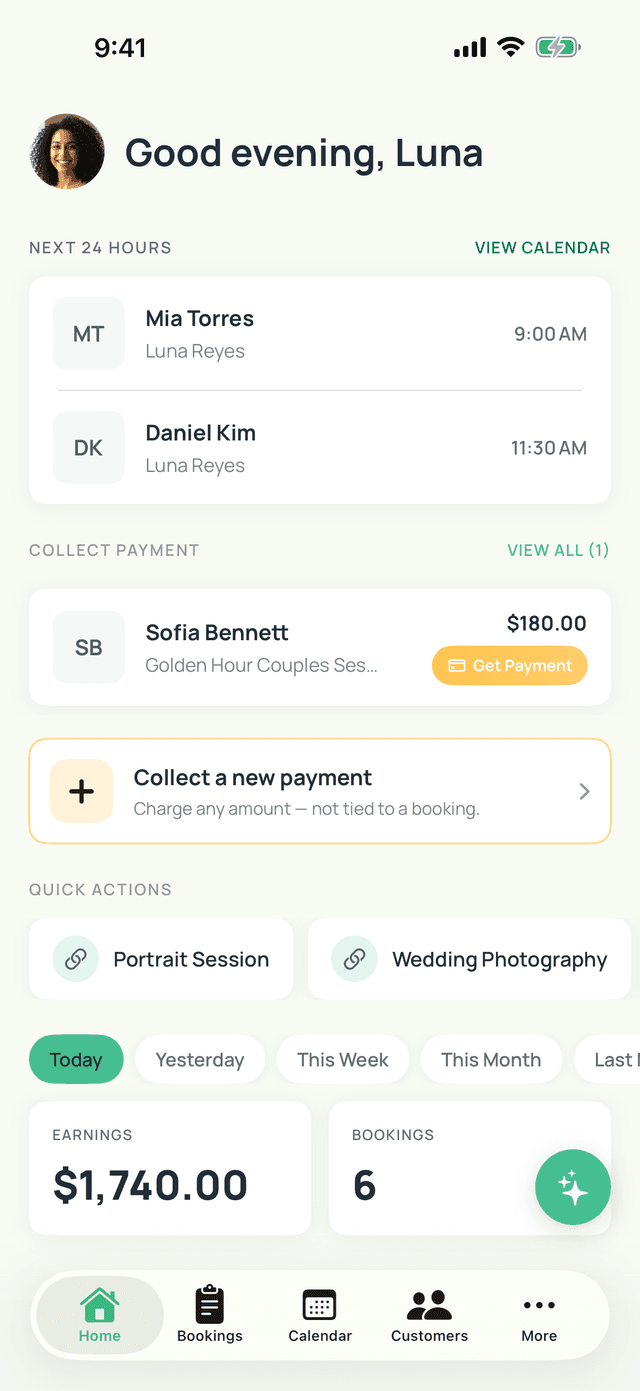
A booking page on your own domain, with payment in the same step. A class with seats on it is the same booking as a session, and the free plan takes the first hundred of either without asking for a card.
- Your booking page, on your own domain or ours
- Card payment in the same step, into your own Stripe account
- A session, a package of six, or a class with a seat count
- Online sessions and classes get their Zoom link automatically


Nothing here is legal, tax or financial advice. Licensing, insurance and whether reiki is regulated where you are all change from one place to the next, and if you sell training there are two authorities in play. The only reliable answer comes from somebody who knows your jurisdiction.