

How to start a lash business
Lashes turn into money two ways: a client on the bed, or a student at the table. Same calendar, same seat, same consent form, and your first payment can come from either one. Underneath both sits the thing this page is most careful about: the certificate you train on is not the license your state may want. The course teaches you the work. Whether you may do that work on a stranger's eyes is your state board's question.
Fourteen things come up when people set out to start a lash business. We measured how often each one gets asked about, then sorted them by something different: whether it actually stops money reaching you. Seven do. Seven can wait, whatever you have been told. Then we measured a fifteenth that nobody asks about at all, and left it on the chart as a control. Both lists are here, with the argument on each side and what each one costs.
Until these are done there is a specific reason the money cannot reach you, whether that money is a full set or a seat on a class. Each one is a yes or no question.
Some people call this procrastination. Others call it going to market. We try not to judge either way. None of them is what is stopping the money.
Measured in October 2026, United States, English. Autocomplete moves, so we re-measure whenever this page is updated.
What do you put on, and what did you train for?
You can only sell what you were trained to do, so this gate is a course before it is a menu. The ladder runs classic, then volume, then mega volume, and the educator course sits at the top of it. A lash lift is a separate certificate, cheaper than an extensions course, and a different line on the price list. The same ladder decides the teaching business. You teach what you were certified in, so the first class you could sell is the course you took, and nothing above it until you have trained in that yourself. Both sides of the fork below are open in the end. This is about which one you start with.
Paste into Claude or ChatGPT. Fill the brackets.
I am trained in [CLASSIC / VOLUME / LASH LIFT / OTHER] and I want to work [FROM HOME / MOBILE / IN A SALON]. List the services I can honestly offer with that training, and separately the ones I would need another course for. For each service, write the name a client would recognize and one sentence saying what happens in it. If I want to teach, name the one class my current certificate would let me teach. Do not describe how anybody will look afterward.
Check before you use it: Anything on the list your certificate does not cover, delete. You sell what you were trained to do, and you teach only what you were certified in.
Do you price the set, or the clock?
Two price ladders run side by side here, and the second is the first read backwards: the numbers you paid to learn are the numbers you charge to teach. On the client side, say the cycle plainly before any number. A full set is one sale. A fill every two to three weeks is the business, and a fill is half to two thirds of a set when it is booked within three weeks. On the teaching side, a seat on a classic one-day course runs $499 to $1,700, in classes of four to six students. The decision underneath is the unit: a menu of sets and fills a stranger can book from, or time on the bed, which charges for however long the work takes.
Prices as published across the US market, checked in October 2026. Suburban and rural prices run noticeably under city prices. They disagree at the edges, and the spread is the answer: there is no going rate, only what your area carries and what you can say without flinching.
Paste into Claude or ChatGPT. Fill the brackets.
I charge [PRICE] for a full set that takes me [TIME] and [PRICE] for a fill that takes [TIME]. I can hold [N] hours on the bed a week, and about [N] of my clients come back for a fill every [TWO / THREE] weeks. I also want to run a classic course for [N] students at [PRICE] a seat, [N] times a year. Show me, with the arithmetic written out, what a month looks like with sets and fills only, and again with the course added. Then show it once more with half the fills missed. Do not tell me what to charge.
Check before you use it: Check one line with a calculator. Arithmetic is where these tools sound most certain and are least reliable.
Does your state want a certificate, or a license?
This is the gate that changes completely depending on where you stand, and it turns on one sentence a course has little reason to put on its own sales page: a course certificate is training, not permission. The one-day certification teaches you the work. Whether you may do that work on a stranger's eyes is your state board's question, and the answer comes in three shapes. Most US states fold lash extensions into esthetician or cosmetology licensing, which means 300 to 1,000 hours of school, 600 the most common, and $2,500 to $15,000 in tuition before kit, exam and license fees. A few states made a lash-specific license: Texas asks for 320 hours at a licensed school and a written and a practical exam, for a license valid two years. A few ask for a training certificate only, or nothing. We do not list which, because the sources disagree and a list goes out of date; your board answers it in one call. Teaching brings a second regulator, in a different office: selling a course that leads to a credential can fall under whoever licenses private or career schools. And insurance arrives with its own condition, a documented patch test.
Paste into Claude or ChatGPT. Fill the brackets.
I want to do lash extensions in [CITY, US STATE OR COUNTRY]. I hold [A COURSE CERTIFICATE / AN ESTHETICIAN LICENSE / A COSMETOLOGY LICENSE / NOTHING YET], and I [DO / DO NOT] intend to teach classes. Write me two separate lists of questions: one for the state board that licenses lash work where I live, and one for the office that licenses private or career schools. Do not answer them. I want the question lists only.
Check before you use it: If it answers one of them with a yes, a no or a number, ignore that part. Those answers come from two different offices, and neither of those offices is an assistant.
Can the money actually reach you?
The quietest gate on the chart at six, and an hour of setup decides whether a booked set is a paid one. A seat on a class is paid up front, because you are holding a place on a date with four to six chairs, and an empty chair is a loss you carry. A set often is not, which is why the fork below is a decision about sets. Deposits are normal in this trade and argued about: a flat nonrefundable deposit of around $30, or half the service, forfeited inside 24 or 48 hours, with a missed fill commonly charged at half and a grace period of ten to fifteen minutes. None of that is the one right answer. All of it has to be written down before the first booking.
Paste into Claude or ChatGPT. Fill the brackets.
Write the payment terms for my lash business as five short lines a client reads once and understands: when payment is due for a set, whether I take a deposit and how much, what happens if somebody cancels inside [NOTICE PERIOD] or misses a fill, how late is too late, and whether I take tips. If I teach, add when a class seat is paid and what happens if a class does not run. My terms are [YOUR TERMS]. Plain language, no legal phrasing, no clauses I did not give you.
Check before you use it: A notice period, a deposit or a fee you did not type is one it invented. All three are decisions, and all three are yours.
Is what you check and what you promise written down?
Busier on the chart than pricing or booking, at a hundred and forty-two, which is unusual for paperwork, and the reason is the adhesive. Every agreement question we collected is a version of one: can you be allergic to lash extensions. Yes, to the adhesive, and it can develop later, even in a regular. So this gate is two documents and a habit. The consent form records what you check and what you promise. The aftercare card goes home with the client and into the confirmation. The habit is the patch test, done and written down before a first treatment, because that record is what your insurer asks to see. A class needs terms a set does not: attendance, refunds, and what the certificate does not entitle the student to do in their state.
Paste into Claude or ChatGPT. Fill the brackets.
Draft a consent form for lash services from my answers. Services: [SERVICES]. What I ask about beforehand: [HEALTH, EYES, CONTACT LENSES, ALLERGIES]. Patch test: [HOW AND WHEN I DO IT]. Photos: [YES / NO / ASK EACH TIME]. Describe what the service is and what it is not, in plain English a client reads once, and write a separate aftercare card of no more than six lines. At the end, list every situation my answers do not cover.
Check before you use it: Any timing, product or medical claim in the draft that you did not give it is one it made up. Strike it, or check it with your insurer before it goes near a client.
Can a stranger book you without a DM?
Instagram is where lash clients live, and "DM to book" is how most techs start. That is the fork below, and both doors can be open at once: the choice is which one is the front door. A set is one slot for one person. A class is one date with four to six seats on it. Both are bookings, which is why this is the gate where the two businesses stop being different at all. The questions underneath are your clients' questions, not yours. Answer them on the page, next to the price, and people stop messaging you to find out.
Paste into Claude or ChatGPT. Fill the brackets.
Write the service list for my lash booking page. I offer [SERVICES] at [PRICES], with these lengths: [LENGTHS]. Fills: [PRICE AND LENGTH], booked every [TWO / THREE] weeks. Add-ons: [ADD-ONS AND PRICES]. I also teach [CLASS] with [N] seats on [DATE]. For each one, write a title and two sentences: what happens in it, and who it suits. Somewhere on the page, answer these four: how long it takes, whether I patch test first, what to do before arriving, and my deposit and cancellation terms. Under 400 words, no promises about how the lashes will look.
Check before you use it: Read it as somebody who has never had lashes done. If they would still have to DM you to find out how long it takes, the page is not finished.
Do the first ten sit in your chair, or somebody else's?
The last gate, because the other six exist to make this one possible. Nothing before it counts until somebody says yes. New techs build a portfolio first, on models at a reduced price, and how to get lash models is a question people ask in so many words. A first room of your own is usually a chair in somebody else's salon first, and a salon chair on commission is where many first clients come from. If you mean to teach, this is also where the two businesses meet: first students come from the client chair, so the people you lash this year are the people at your table next year.
Paste into Claude or ChatGPT. Fill the brackets.
Help me write one message to ten people who already know me. I do [SERVICES] in [WHERE], and I am looking for [N] first clients, or models at [PRICE]. I am also [TEACHING / NOT TEACHING] a class, [WHEN]. Keep it human, keep it short, make it easy to say no, and ask them to think of somebody they know. Give me one version, not three.
Check before you use it: Read it back as if a friend had sent it to you. Whatever sounds like marketing is what stops it being answered.
Worth doing. Not what is stopping you.
Each of these is worth doing, and somebody who does this for a living will tell you it is essential. Somebody else, just as experienced, will call it what people do instead of asking ten people. None of them is the reason the money has not arrived yet.

It belongs here only if you take clients: nobody booking a fill is asking whether you can train somebody else. If you mean to teach, it is not on this list at all. It is gate one, because you teach what you were certified in, and the teaching row sits at sixty-four on the chart. Before paying for one, ask what any "accredited" on its sales page actually refers to.
The busiest row on the whole chart, at three hundred and eighty-one. Home, mobile, a rented chair, a suite by the month: all four are real answers, and every one is easier to pay for once the first fills come back. The suite preset in the calculator below shows what starting in one costs, and it is the largest line on the page. The room is a consequence of clients, not a condition of them.
A hundred and eighty-one on the chart, more than any gate but two, and it is not the part anybody is deciding on when they book. Content and social sit inside this item too, at a hundred and forty-nine. Posting is a job in its own right and a slow one: it pays back over months if you keep at it, and not at all if you do it for three weeks. It is a legitimate channel, and it is not what produces a first booking.
The kit row sits at two hundred and ninety-five, second on the whole chart. A bed and a light are on the gate list in the calculator below, because a set needs somewhere to lie down and something to see by, and a folding bed and a ring light hold a first set. The salon-grade bed, the cart and the room that photographs well can wait. Atmosphere is something you build out of what clients respond to, once there are clients.
Twenty-eight on the chart, much of it people asking how to start a lash brand. That is a different business: inventory, suppliers, retail. A sentence on this page, not a section, and a decision for after you know which products your own clients actually use.
Eleven on the chart, the quietest can-wait row here. Write one when somebody needs to read it, a lender or a partner, or when you are deciding whether to take on a suite. Until then, the seven gates above are the plan.
Brows, lamination, tinting. Stacking a second service before the first has a fill cycle is the classic stall, because a course feels like progress and asking feels like risk. The tell is simple: if you are booking another course this month and you have not yet asked ten people about the thing you are already trained to do, the course is not the bottleneck.
What it costs to open
Start from the way you intend to work, then switch individual lines on and off. Every line is a range rather than a price, because not one of these costs the same thing in two places. Gate items are the seven that stop you being paid. Everything below the rule is the other seven.
Three ways to open, and one bill underneath all of them. Clients from home or mobile open at $1,106 to $3,478, most of it the course, the kit and the bed, and keep open at $106 to $378 a year: insurance, a domain and a booking page. A suite or a rented chair adds $3,600 to $14,400 a year, so that way opens at $4,706 to $17,878 and costs $3,706 to $14,778 a year to keep. It is the largest line on the page, and the one a first client never sees. Teaching opens at $1,592 to $6,478, the same lines plus the educator course, and its real cost is the line showing zero. Where your state wants an esthetician or cosmetology license, that is hundreds of hours of school and could outweigh everything else here put together, and some states want a licensed instructor on top. Neither has a number until your board gives you one.
- $500–$1,700one off
- $0one off
- $300–$800one off
- $200–$600one off
- $96–$260a year
- $0one off
- $10a year
- $0–$108a year
- $0one off
- $300–$1,200a month
- $0one off
- $486–$3,000one off
- $0one off
Published prices in USD, checked in October 2026. Training, insurance and licensing all move with where you are, so no line here is your quote, only the shape of a cost. The lines showing zero have no single number to show: a license only some states ask for, a form you adapt yourself, a room for a class priced by your own town, a product line priced by what you stock. They are listed so you do not forget them, not because they are free.
Gate 6 is the one we can just hand you.
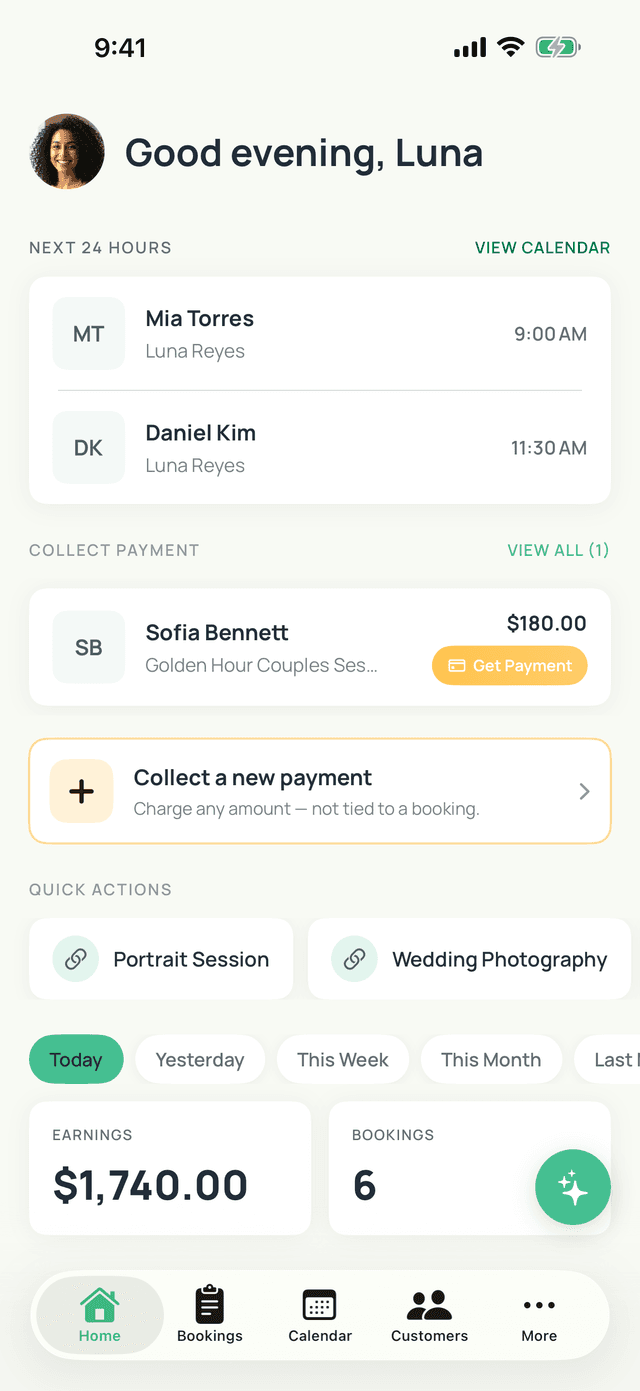
A booking page that works as your bio link, with payment in the same step. A class with seats on it is the same booking as a set, and the free plan takes the first hundred of either without asking for a card.
- A booking page that works as the link in your Instagram bio
- A full set and a fill as separate services, the fill set to recur every two or three weeks
- Pay at booking, or a card on file for the no-show fee, charged with the customer's permission, into your own Stripe account
- A class with a seat count, booked the same way as a set


Nothing here is legal, tax or financial advice. Whether lash work needs a license, what the license takes, insurance and the rules for selling training all change with where you live, and there are two authorities in play. Only somebody who knows your jurisdiction can answer.