

How to start a makeup artist business
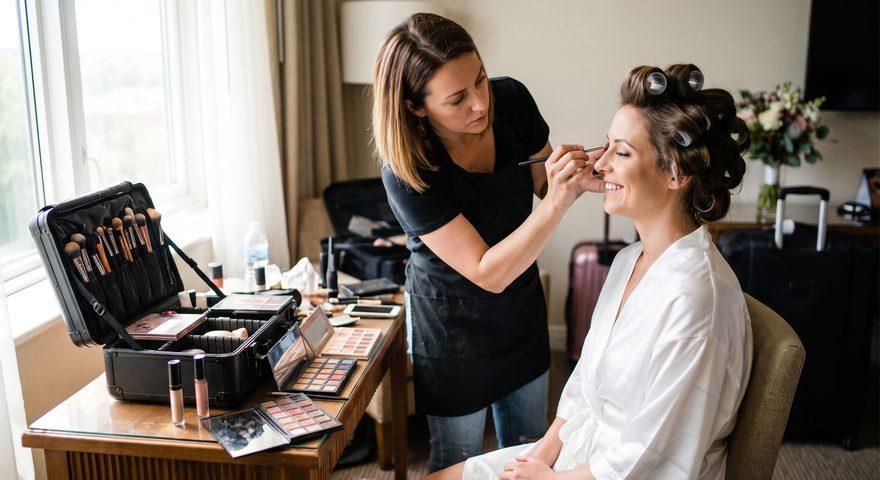
Freelance or a chair: a makeup artist business splits by where the face is. Freelance is a 5 am start at a venue. A chair is a salon booth or suite, rent due Monday. No US state has a license called makeup artist. The face is what the law is about, though: what you touch on it, for money.
Fourteen things come up when people set out to start a makeup artist business. We measured how often each gets asked about, then sorted them by whether it stops money reaching you. Seven do. Seven can wait. A fifteenth that hardly anybody asks about stays on the chart as a control. Both lists are here, with what each costs.
Until these are done there is a specific reason the money cannot reach you, whether it is for a wedding morning next June or a prom face next week. Each one is a yes or no question.
Some people call this procrastination. Others call it going to market. We try not to judge either way. None of them is what is stopping the money.
Measured in October 2026, United States, English. Autocomplete moves, so we re-measure whenever this page is updated.
Work freelance on location, or rent a chair in a salon
Does the chair go to the client, or the client to the chair?
The first decision is where the face is. Freelance means the chair goes to the client: a hotel room or a venue on a wedding morning, at an hour the couple picked. The kit lives in the car, early starts and travel go on the price list, and there is no rent. A chair means the client comes to you: a suite or a booth in a salon, rent due every week whether or not anybody sat in it, and the salon's rules. A few states do not allow booth rental, and inside a licensed salon gate 3 can come out differently.
Paste into Claude or ChatGPT. Fill the brackets.
I live in [CITY OR AREA]. My kit has [WHAT IS IN IT], I have [AMOUNT] to start with, and I can work [DAYS AND HOURS, AND WHETHER THAT INCLUDES SATURDAY MORNINGS]. I [DO / DO NOT] have a car. List the questions I should answer before choosing between working freelance on location and renting a chair, a suite or a booth, and for each one say which answer points toward freelance and which points toward the chair. Do not recommend one.
Check before you use it: If it picks one for you, ignore the pick. The useful part is the list of questions, and the answers to them are yours.
Price per face, and decide where the trial sits
Is the trial the product, or the price of admission?
Per face is the unit in this trade. Hourly turns up only at the edges. A bride sits at the top of the list, the party below her, and around them the lines that move a morning's total: an early start, travel, lashes, airbrush. A beginner who prices by the time in the chair and forgets the prep, the travel and the cleanup pays for it in evenings. The fork below is about the trial. A bride arrives with a date, and the trial is where you win her. Whether to sell it alone or fold it into a package is every bridal artist's choice.
Prices as published across the US market, checked in October 2026. A one-to-one lesson runs $100 to $300 for an hour and a half to two hours, and a group lesson $50 to $150 a seat. Editorial and commercial work is paid by the half day at $300 to $650 or the day at $600 to $1,000, with a kit fee of $75 to $500 on set. The sources disagree at the edges, and the spread is the answer: there is no going rate, only what your area carries and what you can say without flinching.
Paste into Claude or ChatGPT. Fill the brackets.
I charge [PRICE] for a bride, [PRICE] a face for the party and [PRICE] for a trial. A face takes me [MINUTES], and prep, travel and cleanup add [HOURS] to a morning. I can work [N] Saturday mornings in a season, and product, travel and insurance cost me about [AMOUNT] a face. Show me, with the arithmetic written out, what a season looks like if a typical morning is a bride and [N] faces, and again if half the mornings are a bride alone. Do not tell me what to charge.
Check before you use it: Check one line with a calculator. Arithmetic is where these tools sound most certain and are least reliable.
Find out whether paid makeup is licensed where you live, and insure the kit
Is the face you are touching inside the rule where you live?
No US state has a license called makeup artist. States regulate what touches the face, in four shapes. Florida's statute exempts work confined solely to makeup application. California's definition of cosmetology includes beautifying the face with cosmetic preparations. Nevada registers makeup artists who work in a licensed salon. The fourth is the esthetics license, at 600 to 1,000 hours. Strip lashes sit inside a makeup exemption; lash extensions, tinting and anything that exfoliates do not. A makeup-school certificate is not a state license. Ask your state board for the answer. Insurance is two pieces: liability, since venues ask for the certificate, and kit cover.
Paste into Claude or ChatGPT. Fill the brackets.
I do makeup in [CITY, US STATE OR COUNTRY], working [FREELANCE ON LOCATION / IN A SALON / FROM HOME], and I want to offer [SERVICES, INCLUDING ANY LASHES, BROWS OR SKIN PREP]. Write me three separate lists of questions: one for the state board of cosmetology about whether each service is inside or outside what it licenses, one for the city or county clerk about registering the business and working from home, and one for an insurance broker about liability, kit cover and the certificate a venue will ask for. Do not answer them. I want the question lists only.
Check before you use it: If it answers any of them with a yes, a no or a number, ignore that part. Those answers belong to the board, the clerk and the broker, and the rule here has moved three times in two years.
Take a non-refundable retainer, and decide on a minimum
What holds a Saturday in June?
A bride books six to twelve months out, and what holds the date is money. Two words matter. A deposit reads as a part-payment that may come back. A retainer is payment for holding the date and turning away other work. The contract says which, and a sum you call non-refundable has to be a reasonable estimate of what you lose, or a court can read it as a penalty. The hardest clause is the headcount: once it is confirmed, the bride pays for every face on it, whether or not a bridesmaid turns up. The open question is a minimum, and that is the fork.
Paste into Claude or ChatGPT. Fill the brackets.
Write the payment terms for my makeup business as six short lines a bride reads once and understands: what is paid at booking and whether I call it a retainer or a deposit, when the balance is due, my minimum or my second-artist fee, when the headcount is final and who pays for a face that does not show, what happens if she cancels with [NOTICE PERIOD], and whether I take tips. My terms are [YOUR TERMS]. Plain language, no legal phrasing, no clauses I did not give you.
Check before you use it: A notice period, a minimum or a share you did not type is one it invented. Each of those is a decision, and each of them is yours.
Put the headcount, and who pays for it, in the contract
In this trade the contract is the morning. The services and the number of faces. The date, the venue, your arrival time and when the bride is ready. The retainer, the balance date and the cancellation scale. The headcount date, and who pays for the bridesmaid who does not show. Travel, the early start, parking and touch-up hours. Allergies disclosed, and what non-disclosure does to the refund. The portfolio opt-out, which is not enough on its own: the photographer owns the photograph, so posting a wedding face needs their agreement too. A replacement artist if you are ill, and mediation first. Every line is signed months before it is tested.
Paste into Claude or ChatGPT. Fill the brackets.
Draft a one-page bridal makeup contract from my answers. The morning: [DATE, VENUE, ARRIVAL TIME, NUMBER OF FACES, READY-BY TIME]. Money: [RETAINER, BALANCE DATE, CANCELLATION SCALE]. Headcount: [DATE IT IS FINAL, WHO PAYS FOR A FACE THAT DOES NOT SHOW, MY MINIMUM]. Extras: [TRAVEL, EARLY START, PARKING, TOUCH-UP HOURS, LASHES]. Allergies: [WHAT I ASK THE CLIENT TO DISCLOSE]. Portfolio: [OPT-OUT IN THE CONTRACT / ASKED FOR AFTERWARD]. If I cannot make it: [REPLACEMENT TERMS]. Plain English a bride reads once. At the end, list every situation my answers do not cover.
Check before you use it: Any fee, cap or refund wording in the draft that you did not give it is a decision it made for you. Strike it or make it yours, and have a lawyer read anything about a non-refundable retainer.
Let a bride with a date book you without a DM
This trade runs in Instagram messages, and the first is usually: is my date free, and how much? A book button with a starting-at price answers it at midnight. A DM answers it when you read it. The split is by size. A trial, a prom face and a party of three are menu bookings, with a length and a price a stranger can book and pay for. A twelve-face morning is a quote, and the call to quote it can be booked as a service and held as a video call. If you travel, a service area by ZIP code stops a booking from somewhere you do not go.
Paste into Claude or ChatGPT. Fill the brackets.
Write the service list for my makeup booking page. I offer [SERVICES: A TRIAL, A WEDDING MORNING, AN OCCASION FACE, A LESSON] at [PRICES], each [LENGTH], in [AREA, ZIP CODES]. Per face for the party: [PRICE]. Add-ons: [LASHES, AIRBRUSH, AN EXTRA FACE, WITH PRICES]. Travel and early start: [TERMS]. For each service, write a title and two sentences: what is included, and how long it takes. Somewhere on the page, answer these four: how far ahead I take wedding dates, whether the trial is credited, what I need to know about allergies, and whether I take tips. Under 400 words, no promises about how anybody will look.
Check before you use it: Read it as a bride with a date and no time. If she would still have to DM you to find out whether you travel to her venue or what the trial costs, the page is not finished.
Get the first ten faces, from your own chair or somebody else's
The last gate, because the other six exist to make this one possible. Most artists come through one of two doors. Assisting a lead artist puts you on wedding mornings beside somebody who already books them, paid, with a bride and photographs that are theirs. Your own faces, friends first, then cheap or free bookings openly as a beginner and styled shoots, build a portfolio that is yours, and its photographs too if the photographer agrees in writing. Around both sits the referral: photographers, planners, venues and hairstylists, which the trade ranks above advertising. And January and February, when the engagements happen, are the quiet weeks that fill next summer.
Paste into Claude or ChatGPT. Fill the brackets.
Help me write one message to ten people who already know me. I do [BRIDAL / OCCASION / LESSONS] makeup in [AREA], and I am looking for [N] first clients. My first free Saturday is [DATE], and a [SERVICE] costs [PRICE]. Keep it human, keep it short, make it easy to say no, and ask them to think of one person who has just got engaged or has an event coming up. Give me one version, not three.
Check before you use it: Read it back as if a friend had sent it to you. Whatever sounds like marketing is what stops it being answered.
Worth doing. Not what is stopping you.
Each of these is worth doing, and somebody who does this for a living will tell you it is essential. Somebody else, just as experienced, will call it what people do instead of asking ten people. None of them is the reason the money has not arrived yet.

You have makeup. A full makeup artist kit can wait until somebody books it, and so can the pro discount programs. Its first lines are gates, in the calculator below.
A makeup artist certification is training, not a license. Where your state's esthetics or cosmetology definition includes makeup, the program that counts is gate 3. Elsewhere, no certificate stands between you and a paid face.
Most searches here are the reader learning. The hinge: a one-to-one, bride's own-face or bridal-party lesson is a service the day it is on your menu, with a length, a price and a seat count.
Mostly business cards, logos and lists of makeup artist business names, none of which a bride weighs when she books. Pick a name with makeup artist in it and print cards once somebody asks.
People want a makeup artist portfolio template. The feed is where faces go, not where the first booking comes from. Every face on a makeup artist Instagram account needs the client's agreement and the photographer's.
People search for a makeup studio to rent. The client's hotel room comes first, then a salon chair, on the chair preset below. Clients at your house make gate 1's home occupation permit a gate.
A makeup artist business plan is worth writing when somebody needs to read it: a lender, a suite landlord, a partner. Until then, the seven gates are the plan.
What it costs to open
Start from the way you intend to work, then switch individual lines on and off. Most lines are a range, because few of these cost the same thing in two places. Gate items are the seven that stop you being paid. Everything below the rule is the other seven.
Freelance on location opens at $1,199 to $5,623, a year of restocking included, and keeps open at $604 to $3,258 a year. Bridal mornings open at $1,479 to $6,043 and keep open at the same $604 to $3,258. A chair or a suite opens at $7,479 to $36,043 and keeps open at $6,604 to $33,258 a year; the rent alone is more than everything else on that preset. An esthetics program is the biggest one-off line, and your state decides whether it is a gate.
- $400–$1,500one off
- $80–$200one off
- $40–$365one off
- $75–$300one off
- $35–$200a month
- $150–$500a year
- $24–$240a year
- $0a year
- $0one off
- $10a year
- $0–$108a year
- $0one off
- $280–$420one off
- $500–$2,500a month
- $300–$5,000one off
- $3,000–$18,000one off
- $0–$35a year
Published prices in USD, checked in October 2026. Insurance, licensing, permits and sales tax all move with where you are, so no line here is your quote, only the shape of a cost. The lines showing zero have no single number to show: a registration priced by your own town, a contract you adapt yourself, card fees charged on each transaction. They are listed so you do not forget them, not because they are free.
Gate 6 is the one we can just hand you.
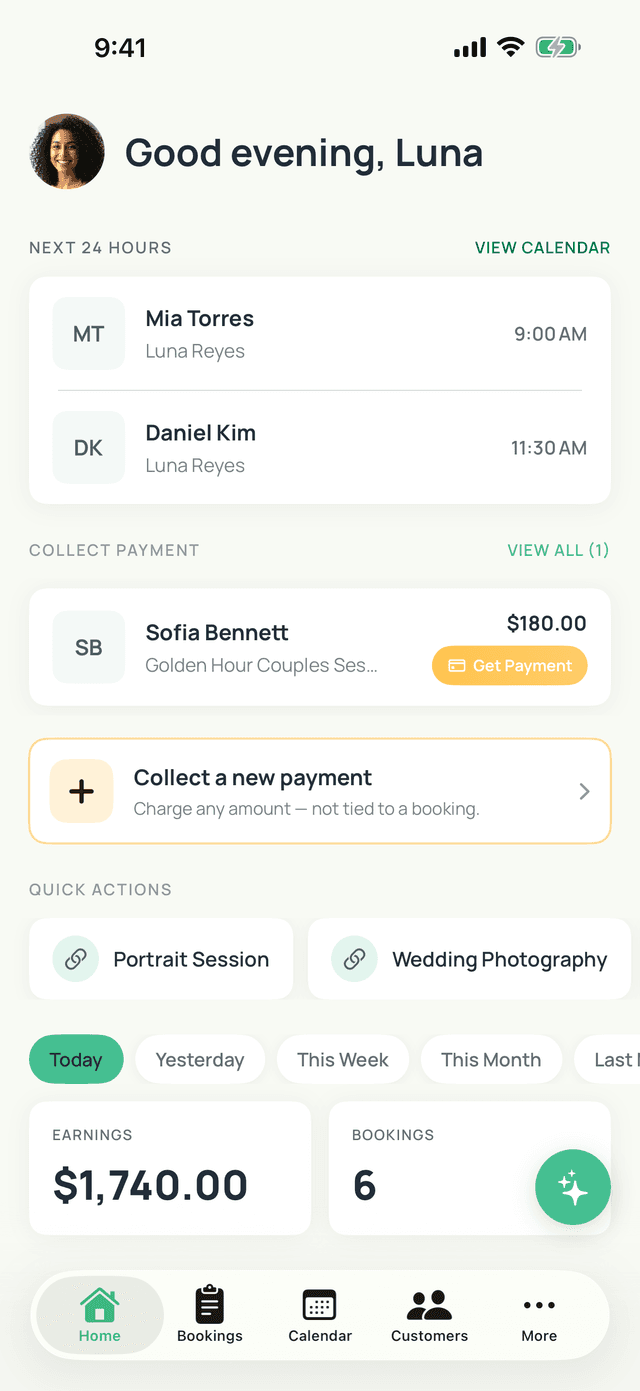
A booking page with payment in the same step, on our address on the Free plan and on your own domain from Solo. For a trial, an occasion face, a lesson or a party from the menu, that is the whole of gate 6. For a wedding morning, it is the half that comes after the quote, and the trial and the day can be sold together as a package. The Free plan takes the first hundred bookings without asking for a card.
- Your booking page, on your own domain or ours, that works as the link in your bio
- The trial, the wedding morning, an occasion face and a lesson as separate services with their own length, price and travel area, and lashes or airbrush as an add-on
- The trial and the wedding day as one package paid once and redeemed as each date arrives, or a card on file charged for the balance with the customer's permission, into your own Stripe account, or tapped on your iPhone at the venue
- A bridal-party lesson with a seat count, and a wedding morning as its own shift that starts before the day does


Nothing here is legal, tax or financial advice. Whether paid makeup is inside or outside the cosmetology act, what a venue needs from your insurer, sales tax, and what a contract can hold a bride to all change with where you live and where the wedding is, and for an artist who travels those can be two different places. Only somebody who knows your jurisdiction can answer, and the rule moved three times in two years.