

How to start a handyman business
In most US states nobody licenses a handyman. The law sets a ceiling on the job instead: a dollar figure, labor and materials together, at or above which the work needs a contractor license. It differs by state. And every job is a new address: a homeowner pays at the door, a property manager pays thirty days after the invoice.
Fourteen things come up when people start a handyman business. We measured how often each gets asked about, then sorted them by whether it stops money reaching you. Seven do. Seven can wait, whatever you have been told. A fifteenth that hardly anybody asks about stays on the chart as a control.
Until these are done there is a specific reason the money cannot reach you, whether it comes from a homeowner at the door or a property manager on an invoice. Each one is a yes or no question.
Some people call this procrastination. Others call it going to market. We try not to judge either way. None of them is what is stopping the money.
Measured in October 2026, United States, English. Autocomplete moves, so we re-measure whenever this page is updated.
Who you work for: homeowners, or landlords and property managers
One job at a new address, or the same twenty doors every month?
A homeowner books the same day or the same week, at a house you have never seen, and pays on completion. Every job is a new address, so the marketing never stops. A landlord or property manager sends work orders to the same doors for years. Against that, net-30 is the norm, many work orders carry a not-to-exceed figure, an account can take weeks or months to win, and you float about 45 days of materials. The common advice is a mix; this is about where you start. The searches here say who is asking: no money, no experience, on the side.
Paste into Claude or ChatGPT. Fill the brackets.
I live in [CITY OR AREA]. I can fix [THE JOBS I AM GOOD AT], I own [TOOLS AND VEHICLE], I have [AMOUNT] to start with, and I can work [DAYS AND HOURS, AND WHETHER THIS IS ON THE SIDE]. List the questions I should answer before choosing between homeowners and property managers as my first customers, and for each one say which answer points toward each. Do not recommend one.
Check before you use it: If it picks one for you, ignore the pick. The useful part is the list of questions, and the answers to them are yours.
How to price handyman work: by the hour, or by the job
Hourly is fair and transparent, and it punishes you for being fast. A flat price rewards speed and carries the risk of the job that turns into a wall. Then the minimum: at, say, $75 an hour, a two-hour minimum is $150 for a job that took thirty minutes. A trip fee covers an address outside your area or a run for parts. Materials go on as a markup, with the receipts available, and special-order parts are paid up front. Many property manager work orders come with a not-to-exceed figure.
Prices as published, with the customer supplying the parts, checked in October 2026. A TV on brick or over a fireplace runs $125 to $250, a larger drywall patch $150 to $350. There is no going rate, only what your area carries.
Paste into Claude or ChatGPT. Fill the brackets.
I charge [HOURLY RATE] with a [MINIMUM] minimum, or [FLAT PRICES FOR MY COMMON JOBS]. In a typical week I do [N] jobs, each taking [HOURS] plus [DRIVING TIME], and I handle materials as [CUSTOMER SUPPLIES PARTS / I BUY PARTS WITH RECEIPTS AVAILABLE / SPECIAL ORDERS UP FRONT]. Show me, with the arithmetic written out, a month at [N] billable hours a week, and again if half my jobs are shorter than the minimum. Then price the same month the other way. Do not tell me what to charge.
Check before you use it: Check one line with a calculator. Arithmetic is where these tools sound most certain and are least reliable.
Do you need a license, and what insurance to carry
Are you under your state's ceiling?
In most US states nobody licenses a handyman; the law caps the job. The cap comes in three shapes. A ceiling per job: California's is $1,000, only for work with no permit and no employees, with adverts saying you are unlicensed. Oregon's exemption ends when you advertise, business card included. Registration for any paid work: Washington and New Jersey. No state license, the city decides: Texas. Your state's contractor board has the figure. Nearly everywhere, electrical beyond a like-for-like swap, new plumbing lines, gas and refrigerant are licensed at any price, and permitted work is outside the exemption. Property managers ask for proof of insurance before the first work order.
Paste into Claude or ChatGPT. Fill the brackets.
I do handyman work in [CITY AND STATE]. The jobs I want to take are [LIST], and the biggest would cost about [AMOUNT] with materials. Write me three separate lists of questions: one for my state's contractor board about the ceiling and which of my jobs fall under it, one for my city or county about registering the business, and one for an insurance agent about liability, tools cover and my vehicle. Do not answer them.
Check before you use it: If it answers any of them with a yes, a no or a dollar figure, ignore that part. The ceiling changes by state, and only the board has the current figure.
How you get paid, and who pays for the materials
Can the money reach you at the door?
Taking payment sits at 29 on the chart, most of it the wage question. A homeowner pays on completion, and a card at the door closes the job fastest; an iPhone can take one with no reader. A property manager pays net-30. The deposit in this trade is for materials, not the date. A large up-front payment for a small job is a red flag homeowners are told to watch for. A multi-day or material-heavy job takes a deposit for the materials at signing, special-order parts up front. Some states cap the deposit a licensed contractor may take.
Paste into Claude or ChatGPT. Fill the brackets.
Write the payment terms for my handyman business as five short lines a customer reads once and understands: when a small job is paid, which jobs carry a deposit for the materials, how special-order parts are paid, how I take payment at the door, and whether I take tips. My terms are [YOUR TERMS]. Plain language, no clauses I did not give you.
Check before you use it: A deposit, a fee or a deadline you did not type is one it invented. Each of those is a decision, and each of them is yours.
Put the job in writing before you start
In this trade the written estimate does the work of a contract. It carries the scope task by task; what is excluded, like hidden conditions behind the wall; materials and who supplies them; the price or the rate and the minimum; when it is paid; change orders in writing before extra work starts; the warranty on your labor, 30 days to a year, one year most common; and a valid-until date. Some states require a home improvement contract above a figure in writing: California and New Jersey above $500, Maryland always. For a small job, a text confirming scope and price is the written estimate in most places.
Paste into Claude or ChatGPT. Fill the brackets.
Draft a one-page handyman estimate from my answers. The job, task by task: [SCOPE]. Excluded: [EXCLUSIONS]. Materials and who supplies them: [MATERIALS]. Price: [FLAT PRICE, OR RATE AND MINIMUM]. Payment and any materials deposit: [TERMS]. Change orders: [HOW I HANDLE EXTRA WORK]. Warranty on my labor: [PERIOD]. Valid until: [DATE]. Plain English. At the end, list every situation my answers do not cover.
Check before you use it: Any warranty period, deposit or deadline you did not give it is a decision it made for you. Strike it or make it yours, and have somebody who knows your state read anything that looks like a legal promise.
How customers book you: online, or after a quote
Can a stranger book you without a phone call?
A two-hour visit, a half day and a full day are services with a length and a price, booked from your site and paid at booking or at the door. A job nobody can see from the street is a quote first, from photos for familiar jobs or a visit for what is under the floor, then a date. A service area by ZIP means an address you will not drive to cannot book you. Property managers send work orders instead. Being bookable is the quietest gate, at 13; the stranger ready to book at ten at night does not care how quiet the row is.
Paste into Claude or ChatGPT. Fill the brackets.
Write the service list for my handyman booking page. I offer [A TWO-HOUR VISIT / A HALF DAY / A FULL DAY / FLAT-PRICE JOBS] at [PRICES], in [AREA OR ZIP CODES]. Add-ons: [A SECOND PERSON, A MATERIALS RUN, DISPOSAL, WITH PRICES]. For each service, write a title and two sentences: what fits in it, and what does not. Somewhere on the page, answer who supplies the parts, what happens if the job runs over, which jobs need photos and a quote first, and whether I take tips. Under 400 words, no promises about results.
Check before you use it: Read it as somebody who has never hired a handyman. If they would still have to call you to find out whether the job fits in two hours or who buys the parts, the page is not finished.
Where the first ten customers come from
A lead site, or your own street?
Nothing before this gate counts until somebody books you. The row sits at 35, mostly marketing questions. A lead site brings work from the first week, but leads are shared, cost $10 to $80 each and occasionally over $150, some sites add a subscription, and the customer and the review belong to the site. Your own neighborhood means a sign on the truck, door hangers, neighborhood apps and local groups, a card left at every job, and referrals from the first ten. It is slow, and every customer it brings is yours. Property manager accounts are won with a certificate of insurance and a visit to the office.
Paste into Claude or ChatGPT. Fill the brackets.
Help me write one message to ten people who already know me. I do handyman work in [AREA], I am looking for [N] first customers, and I take jobs like [THREE JOBS I DO WELL]. My first free day is [DAY], and a [TWO-HOUR VISIT / JOB] costs [PRICE]. Keep it short, make it easy to say no, and ask them to think of one person with a list of small jobs that never gets done. One version, not three.
Check before you use it: Read it back as if a friend had sent it to you. Whatever sounds like marketing is what stops it being answered.
Worth doing. Not what is stopping you.
Each of these is worth doing, and somebody who does this for a living will tell you it is essential. Somebody else, just as experienced, will call it what people do instead of asking ten people. None of them is the reason the money has not arrived yet.

195 on the chart, the loudest row. A homeowner is more likely to care about scope, price and insurance. Print cards once somebody asks. In Oregon the card ends the license exemption.
65 on the chart. You have most of them. The next tool is bought with the job that needs it; the ones you are missing now are the calculator's first line.
37 on the chart, all of it somebody learning. No state asks for a certificate, a certificate is not a license, and the ceiling applies to a certified handyman exactly as to an uncertified one.
22 on the chart. The car you have can do the job for a solo handyman, with a rack later. The day the vehicle is the business, commercial auto becomes a gate.
18 on the chart, and the only item here a customer never sees. Write one when a lender or a partner needs to read it.
15 on the chart. It depends where you are: a separate entity puts the business on its own paper, and costs a filing and upkeep that trading under your own name does not.
4 on the chart, the quietest of the seven. Before-and-after photos are the trade's content; they show your work, and the first booking more often comes from somebody who knows you.
What it costs to open
Start from the way you intend to work, then switch individual lines on and off. Every line is a range rather than a price, because not one of these costs the same thing in two places. Gate items are the seven that stop you being paid. Everything below the rule is the other seven.
Under the ceiling, on your own car, opens at $1,390 to $5,718 and keeps open at $690 to $2,218 a year, mostly two policies. A van and a rack opens at $8,390 to $23,018 and keeps open at $690 to $4,518 a year; the van alone costs more than everything else on that preset. Licensed, the bigger jobs, opens at $1,690 to $10,018 and keeps open at $690 to $4,518 a year. The license adds $300 to $2,000 once; commercial auto, up to $2,300, comes back every year.
- $500–$2,000one off
- $200–$1,500one off
- $480–$1,300a year
- $200–$500a year
- $0–$2,300a year
- $0–$300a year
- $0one off
- $10a year
- $0–$108a year
- $0one off
- $300–$2,000one off
- $7,000–$15,000one off
- $0–$1,500one off
- $50–$500one off
- $0–$300one off
Published prices in USD, checked in October 2026. Insurance, the ceiling, registration and sales tax move with where you are, so no line is your quote. Materials are taxed nearly everywhere there is a sales tax; most states do not tax repair labor on a home, some do, and your state revenue department answers it. A line showing zero has no single number, not no cost.
Gate 6 is the one we can just hand you.
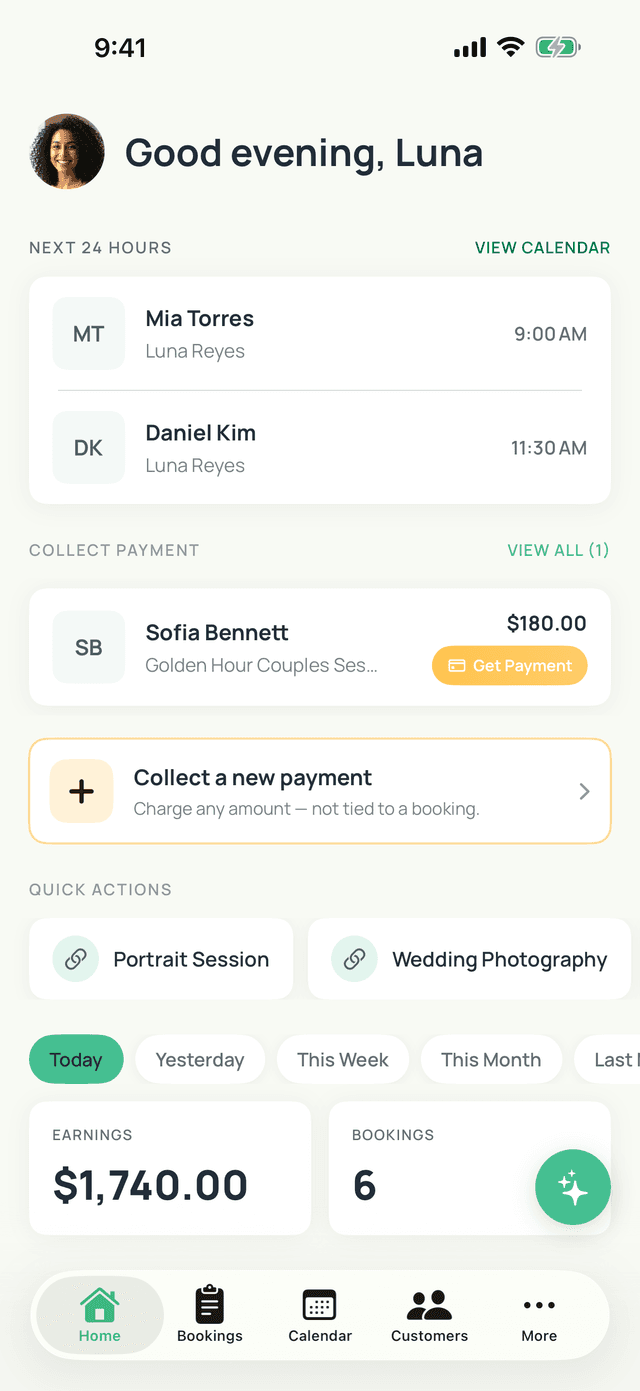
A booking page on your own domain, with payment in the same step. For a two-hour visit, a half day or a full day, that is all of gate 6. For a job quoted first, it handles the date and the card after the quote. The free plan takes the first hundred bookings without asking for a card.
- Your booking page, on your own domain or ours, booked at any hour with no call to answer
- A two-hour visit, a half day and a full day as separate services with their own length and price, and a materials run or a second pair of hands as an add-on
- A service area by ZIP, so an address you will not drive to cannot book you
- A card tapped on your iPhone at the door with no reader, or a card on file charged for the balance with the customer's permission, into your own Stripe account


Nothing here is legal, tax or financial advice. The license ceiling, the trades, permits, insurance, sales tax and what an estimate can hold you to change with where you live and where the job is. Only somebody who knows your jurisdiction can answer.