

How to become a yoga instructor
Nobody licenses a yoga teacher. What stands in for the license is a 200-hour certificate, an insurer who wants to see it, and a waiver your students sign. Answers to this question tend to stop at the certificate. This one goes on to the first paid class, which comes from a studio's schedule or from your own students. Most teachers do both, in that order.
Fourteen things come up when people set out to become a yoga instructor. We measured how often each one is asked about, then sorted them by whether it stops money reaching you. Seven do. Seven can wait. A fifteenth that nobody asks about is on the chart as a control. Each decision below shows both sides and what it costs.
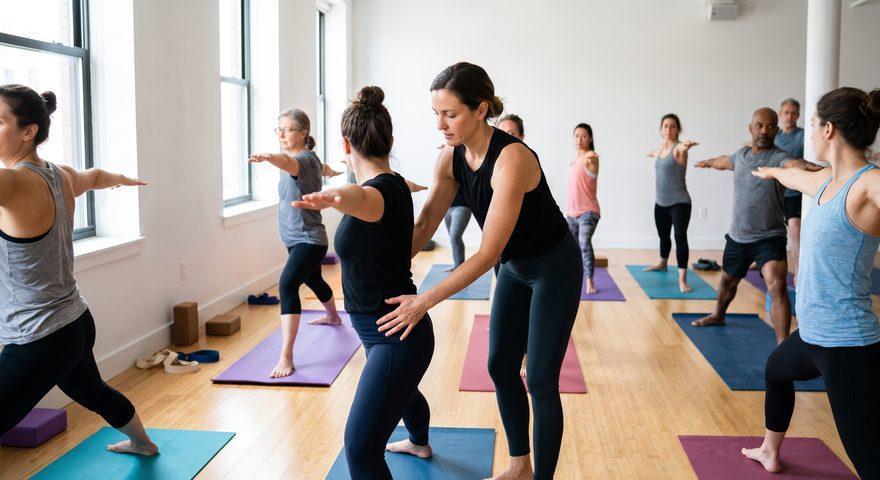
Until each of these is done, money cannot reach you, from a studio or from your own students. Each is a decision to make before the first paid class.
Some call this procrastination, others call it going to market. We try not to judge. None of it is what is stopping the money.
Measured in October 2026, United States, English. Autocomplete moves, so we re-measure whenever this page is updated.
Choose how you take the 200-hour training: weekends at a local studio, or an intensive away or online
The hours are the same either way. What changes is how long it takes and who watches you teach.
The 200-hour course is all classroom hours: techniques and practice are the largest block, then anatomy, the humanities of yoga and professional essentials. At a local studio it costs $2,500 to $5,000, as weekends over three to six months or a three to four week intensive. Online with a live cohort it is $1,200 to $4,500, and self-paced starts at $300. Bali and Costa Rica run $2,400 to $5,500 with lodging and meals, India $750 to $1,600, flights never included. Tuition commonly leaves out books, insurance and the registry fee. Finishing the course does not book you a class, and the weekend course at a local studio is how most people end up on that studio's sub list.
Paste into Claude or ChatGPT. Fill the brackets.
I live in [CITY OR AREA], have done yoga for [YEARS], can spend [AMOUNT] on training, and can study [WEEKENDS / A MONTH AWAY / EVENINGS ONLINE]. List the questions I should answer before choosing between weekends at a local studio and an intensive away or online, and which answer points which way. Then list what to ask a school about what its tuition leaves out. Do not recommend a school or a format.
Check before you use it: If it names a school or picks a format, ignore that part. The answers are in each school's small print.
Decide whose students you teach: a studio's schedule, or your own
Most teachers do both, studio first.
On a studio's schedule the studio brings the room, the students, the waiver and the music license, and pays $30 to $75 a class at most studios, the same for two students as for a full room. With your own students, in a private or a class of your own, every student is yours, and so is every empty mat. Most studios engage teachers as independent contractors, but the label is state law, and one large state's test makes a studio teacher likely an employee. Studio contracts commonly carry a clause against teaching elsewhere or taking students with you, and whether it holds is state law too. Ask before you sign, and ask whether a class canceled for low numbers is paid.
Paste into Claude or ChatGPT. Fill the brackets.
I have [MY CERTIFICATE / NEARLY FINISHED MY TRAINING], live in [CITY OR AREA], and can teach [DAYS AND HOURS]. A studio has offered me [N] classes a week at [RATE] as a [CONTRACTOR / EMPLOYEE]. List the questions to ask before I sign, about pay, canceled classes, subbing, insurance and any clause about teaching elsewhere or taking students. Then list questions for myself about running my own class. Do not tell me which to choose or whether a clause is enforceable.
Check before you use it: If it says a clause would or would not hold, ignore that line. That is state law, and a lawyer where you live answers it.
Get the four things that stand in for a license nobody issues: insurance, a waiver, the music license and the park permit
Nobody licenses a yoga teacher, but insurers, halls and parks ask for proof.
No US state licenses, registers or certifies a yoga teacher. Four things stand in for it. Insurance: general and professional liability for a solo teacher runs $79 to $450 a year. A waiver: the student accepts the risk of injury and releases you; a studio's may name you, but your own class needs its own. A music license: a personal streaming subscription does not cover a class; on a studio's schedule the studio pays, and in a hall or a park you do. A park permit: a class in a public park is commercial use. A business registration or home occupation permit may also apply. Registering with Yoga Alliance, the main teacher registry and a private body, is voluntary.
Paste into Claude or ChatGPT. Fill the brackets.
I want to teach yoga in [CITY AND STATE], at [A STUDIO / A RENTED HALL / A PARK / MY HOME / ONLINE]. Write separate question lists: for an insurer about liability cover and online classes, for the city or county clerk about registration and a home occupation permit, for the parks department if I teach outdoors, and for whoever runs the room about their insurance and music license. Questions only, no answers.
Check before you use it: If it answers any of them with a yes, a no or a number, ignore that part. The offices, room owners and insurers give those answers.
Know what a studio pays per class or per head, and what a private pays per hour
Most studios pay a flat rate. Some pay by the head.
Most studios pay a flat $30 to $75 a group class. Others pay by the head. Some pay for an empty room and some require one student. The official median for fitness trainers and instructors, the occupation yoga teachers fall under, was $47,160 in 2025, but it is drawn mostly from people on a payroll. Your own arithmetic is the better answer: classes a week times the rate, plus privates, less unpaid travel and planning. Twenty classes a week at $30 is about $30,000 a year before anything else. One teacher's rule divides the class fee by two and a half for travel and preparation, which makes $30 a class about $12 an hour.
Prices as published across the market, checked in October 2026. A donation class suggests $10 to $15 with a floor of about $5, an online live drop-in runs $10 to $20, and a two to three hour workshop $25 to $100 a seat. The sources disagree at the edges and there is no single going rate, so use the range for your area.
Paste into Claude or ChatGPT. Fill the brackets.
I teach [N] classes a week at [RATE], paid [FLAT / BY THE HEAD: BASE AND RATE A HEAD], plus [N] privates a week at [PRICE]. Each class takes [HOURS] of travel, planning and setup on top. With the arithmetic written out, show me a year, what I earn for each hour it really takes, and the same if [N] classes a month are canceled for low numbers. Do not tell me what to charge.
Check before you use it: Check one line with a calculator. These tools often get arithmetic wrong.
Pick how students pay you: a drop-in at booking, or a pass bought up front
On a studio's schedule the studio decides this. With your own students, you do.
A teacher with her own class sells in three shapes. A drop-in, $15 to $30, is paid at booking or at the door. A ten-class pass, $120 to $220 and priced a little below ten drop-ins, is bought up front, and a credit is drawn each visit. The trade writes an expiry of six to twelve months into a pass. The third shape is a weekly private, set once to recur and charged each time with the customer's permission. A late cancel or a no-show on a pass uses the credit, and 24 hours is the common cancellation window for a private. Put all of it in writing before students book.
Paste into Claude or ChatGPT. Fill the brackets.
Write the payment terms for my yoga class as five short lines a student understands on one read: what a drop-in costs and when it is paid, what a [N]-class pass costs and how long it lasts, what happens to a credit after a late cancel or a no-show, my cancellation window for privates, and whether I take tips. My terms are [YOUR TERMS]. Plain language, and no clauses I did not give you.
Check before you use it: A window, a fee or an expiry you did not type is one it invented. Each of those is your decision.
Let a student book a class and pay for it without messaging you
A studio has its own booking system. Your own class needs one.
Your own class needs a schedule with a book button, a seat count so the twelfth mat is the last one sold, a drop-in paid at booking, a pass drawn down, a private that recurs weekly, a six-week beginners' series booked by its start date, a video link for the online class, and the link in your bio. If you travel for home privates, a service area by ZIP or postal code stops bookings from places you do not go. For six friends in a hall, messages and a list work too.
Paste into Claude or ChatGPT. Fill the brackets.
Write the class list for my yoga booking page. I teach [CLASSES] at [PRICES], each [LENGTH], with [N] mats, at [PLACE OR ONLINE]. A [N]-class pass costs [PRICE]. Privates are [PRICE] for [LENGTH], at [WHERE]. For each, write a title and two sentences: who it is for and what to bring. Also answer how long it lasts, what level it suits, what happens if either of us cancels, and whether I take tips. Under 400 words, and no promises about what yoga will do for anybody.
Check before you use it: Read it as somebody who has never been to your class. If they would still have to message you about what to bring or how long it lasts, it is not finished.
Find the first ten students: subbing at a studio, or a launch class of your own
Most teachers start one of these two ways.
The row sits at 32, the quietest gate on the chart. Subbing and community classes at a studio pay from the first day and put you in front of the studio's regulars, and privates come out of that room. A donation or free launch class of your own, offered openly as one for the first ten or twenty classes, is a rehearsal where every student is yours, and the first one may be empty. One teacher's first four sessions drew none, none, nine and fifteen. A free class for an office can become a paid weekly one. An email list of about two hundred people is enough to fill a first small series.
Paste into Claude or ChatGPT. Fill the brackets.
Help me write one message to ten people who already know me. I teach [STYLE] in [AREA OR ONLINE], and my first class of my own is on [DAY] at [PLACE], [DONATION / FREE / PRICE]. Keep it short, make it easy to say no, and ask them to think of one person who has wanted to try a class. One version, not three.
Check before you use it: Read it as if a friend had sent it to you, and cut anything that sounds like marketing.
Worth doing, but not what stops the first paid class
Somebody who does this for a living will call each of these essential. Somebody just as experienced will say it can wait until you have asked people to come to a class. None of them is why the money has not arrived.

303 on the chart, the loudest row on the page and louder than the training. Sequencing, themes and what follows the warm-up are learned on the first ten classes. A studio's regulars forgive more than you think.
147 on the chart, and 110 more that name a place. Three hundred hours at $2,000 to $6,500, or a specialty: prenatal, kids, yin, chair. A specialty is gate one the day a studio books you for it.
60 on the chart. The feed and the website belong here too: they announce classes, and gate 7 is where the first students come from. Print cards once somebody asks for one.
47 on the chart, and 14 more that name a place. Rent is owed whether the mats are full or empty, so start with a hall by the hour. If students come to your house, the home occupation permit is a gate.
46 on the chart. The playlist can wait, but the music license is in gate 3: a personal streaming subscription does not cover a class.
38 on the chart. A clip-on microphone at $95 to $200 and a video call. Before the first stream, check whether your insurance covers material open to the general public.
24 on the chart, and usually a second income for established teachers. What you paid to qualify is what you would charge to train. Selling a seat is gate one again: a date, a seat count, a payment. Your own teacher training can fall under state career-school rules.
What it costs to open
Start from the way you intend to work, then switch lines on and off. Every line is a range because most of these costs move by place. Gate items are the seven that stop you being paid; everything below the rule is the other seven.
The training is the largest line on every preset. On a studio's schedule it is nearly the whole bill: that way opens at $1,329 to $5,665 and keeps open at $79 to $515 a year, which is insurance and, if you join it, the registry. Your own class in a hall opens at $2,309 to $11,693 and keeps open at $979 to $6,243 a year, and the line that keeps coming is the room: a weekly hall at the top of the band is $4,800 a year, about what the training cost once. Online opens at $1,554 to $6,847, most of it the training and a microphone, and keeps open at $209 to $1,497 a year, most of that insurance and music. The registry's $50 application is paid once on top, if you join.
- $1,200–$5,000one off
- $0–$65a year
- $79–$450a year
- $0a year
- $50–$150one off
- $0one off
- $80–$300one off
- $60–$400a month
- $50–$150a year
- $120–$660a year
- $10a year
- $0–$108a year
- $0one off
- $95–$200one off
- $0–$204a year
- $150–$6,500one off
- $50–$120one off
- $30–$90one off
- $0one off
Published prices in USD, checked in October 2026. Insurance, registration, permits and music licensing move with where you are, so no line here is a quote. Lines at zero have no single number: a registration priced by your town, a waiver you adapt yourself, card fees charged per transaction, a retreat deposit priced by the venue. They are listed so you do not forget them.
Start with a class students can book and pay for.
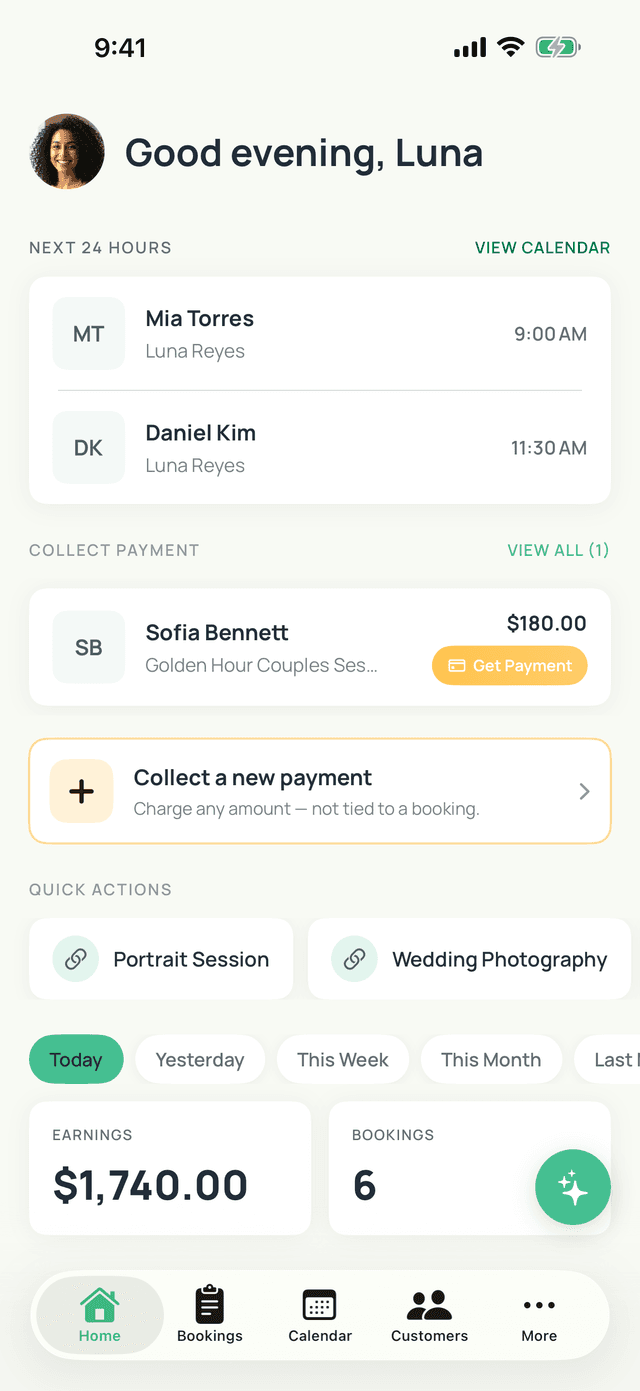
A booking page on our domain, or on your own domain on Solo at $9 a month, with payment in the same step. For a teacher on a studio's schedule, it covers the half that is yours: the privates and the Saturday class in the hall. The free plan takes the first hundred bookings without asking for a card.
- A booking page on our domain, or on your own domain on Solo, that works as the link in your bio
- A class with a seat count, a drop-in, a private and an online class as separate services with their own length and price, and a six-week course the student books by its start date
- A pass bought up front and drawn down each booking, a drop-in paid at booking, or a weekly private charged each time with the customer's permission, into your own Stripe account, or tapped on your iPhone at the door
- A video link made for the online class


Nothing here is legal, tax or financial advice. Licensing, permits, insurance, what a waiver can hold you to, and whether a studio can call you a contractor all change with where you live and where you teach, and for a teacher who travels or teaches online those can be different places. Only somebody who knows your jurisdiction can answer.