

How to start a photography business
Weddings or sessions: photography splits by the calendar before it splits by anything else. A wedding is one date a year out, held with a retainer and shot in a single day with no second take. A session is an hour next month, sold from a menu, and the family comes back next year. Both run on the same machinery underneath: a date, a price, a way to be paid, a file delivered. And nobody licenses a photographer. The picture is the product, though, and the law is about the picture: whose it is, whose face is in it, and where it was taken.
Fourteen things come up when people set out to start a photography business. We measured how often each one gets asked about, then sorted them by something different: whether it actually stops money reaching you. Seven do. Seven can wait, whatever you have been told. Then we measured a fifteenth that hardly anybody asks about, and left it on the chart as a control. Both lists are here, with the argument on each side and what each one costs.

Until these are done there is a specific reason the money cannot reach you, whether it is for a wedding a year out or a session next month. Each one is a yes or no question.
Some people call this procrastination. Others call it going to market. We try not to judge either way. None of them is what is stopping the money.
Measured in October 2026, United States, English. Autocomplete moves, so we re-measure whenever this page is updated.
One date a year out, or an hour next month?
The first decision in this trade is the shape of the calendar, and it sets everything after it. A wedding is one date, booked nine to eighteen months out and held with a retainer, then eight hours with no second take, often with a second shooter beside you, and a gallery delivered weeks later. The peak Saturdays go first, and the slow season runs roughly January to April. A session is an hour, booked weeks out, sold from a menu, and the family that liked last year's pictures comes back for the fall rush. Underneath, it is the same machinery: a date, a price, a way to be paid, a file delivered, and both end up booked, paid and delivered the same way. The questions people bring here say who is asking: with no money, with no experience, on the side, from home. The camera is already in the bag. This is about which calendar you start with.
Paste into Claude or ChatGPT. Fill the brackets.
I live in [CITY OR AREA]. I own [CAMERA AND LENSES], I have [AMOUNT] to start with, and I can shoot [DAYS AND HOURS, AND WHETHER THAT INCLUDES SATURDAYS]. List the questions I should answer before choosing between weddings and portrait sessions, and for each one say which answer points toward weddings and which points toward sessions. Do not recommend one.
Check before you use it: If it picks one for you, ignore the pick. The useful part is the list of questions, and the answers to them are yours.
Is the price for the hour, or for the pictures?
A client pays for an hour with you and receives the pictures, and the price has to cover both, plus the hours at a desk nobody sees. A one-hour family session delivers 20 to 50 edited images, and a wedding 400 to 800 from an eight to ten hour day. A beginner who prices by the hour shot and forgets the editing pays for it in evenings. The trade's own argument is about what happens after the session. Shoot-and-burn delivers an edited gallery and sells nothing after. In-person sales charges a session fee, then holds a second meeting to sell prints, wall art and albums. The headshot and the mini are where a menu price works. The wedding is where nobody quotes without a call, because the hours, a second shooter and the travel all move the number.
Prices as published across the market, checked in October 2026. Newborn sessions run $250 to $1,100 and senior portraits mostly $200 to $600. The sources disagree at the edges, and the spread is the answer: there is no going rate, only what your area carries and what you can say without flinching.
Paste into Claude or ChatGPT. Fill the brackets.
I want to charge [PRICE] for a [SESSION TYPE] that delivers [N] edited images. Shooting takes me [HOURS], editing takes me [HOURS], and I can do [N] a week. Show me, with the arithmetic written out, what a month looks like at that price if [SHARE] of my slots sell, and again if the editing takes twice as long as I expected. Do not tell me what to charge.
Check before you use it: Check one line with a calculator. Arithmetic is where these tools sound most certain and are least reliable.
Are you allowed to shoot there, and who owns the picture?
Nobody licenses a photographer. No US state licenses photography as a trade, and what the law cares about is the picture: whose it is, whose face is in it, and where it was taken. The business needs ordinary paperwork: a registration from your city or county, a DBA if you trade under a name, and a seller's permit if you sell prints. Prints are taxed nearly everywhere there is a sales tax, states split on the session fee and the digital gallery, and the state revenue department is who answers it. The picture is yours the moment the shutter closes. The client gets a license to use it, which the trade calls a print release, and a copyright release, which hands over ownership, is a different and rarer thing. Registering with the US Copyright Office costs $55 for up to 750 published photographs from one year, and the three months after first publication are why it is worth doing. A recognizable face in an ad needs a model release, signed by a parent for a child. Since January 2025 a small shoot in a national park needs no permit, while a city, a botanic garden or a property owner may want one, a fee or their permission. The one real license in the trade is for the drone: a knowledge test, a registration and a ceiling of 400 feet. Insurance comes in three pieces: liability, because the venue will ask for the certificate, equipment cover, and failure-to-deliver cover for the day a card fails.
Paste into Claude or ChatGPT. Fill the brackets.
I photograph [WEDDINGS / SESSIONS] based in [CITY, US STATE OR COUNTRY], and I shoot in [THE PLACES I WOULD USE: PARKS, GARDENS, STREETS, VENUES]. Write me three separate lists of questions: one for the city or county clerk about registering the business, one for the state revenue department about whether my session fee, my digital gallery and my prints are taxed, and one for each place I shoot about whether I need a permit. Do not answer them. I want the question lists only.
Check before you use it: If it answers any of them with a yes, a no or a number, ignore that part. Those answers come from offices, and none of those offices is an assistant.
Can the money reach you before the pictures do?
The quietest gate on the chart, at 19, and the one where the money is. In this trade it arrives early: a wedding retainer is paid a year before the gallery, and a mini session is paid at booking. So this gate is about two words. A retainer is payment for holding the date and turning away other work. A deposit sounds like a part-payment, something that may have to be given back. The contract says which, and a sum you call non-refundable has to be a reasonable estimate of what you lose, or a court can void it as a penalty; some states are more skeptical than others. In the UK, a booking made online carries a 14-day cooling-off right, and a booking fee has to be reasonable. For a wedding the shape is settled: a retainer of a quarter to a half, the balance two to four weeks before the day, and payment plans common. For sessions it is an open choice, and that is the fork below.
Paste into Claude or ChatGPT. Fill the brackets.
Write the payment terms for my photography business as five short lines a client reads once and understands: what is paid at booking and whether I call it a retainer or a deposit, when the balance is due, what happens if they cancel or do not show, how a session is moved for weather or with [NOTICE PERIOD], and whether I take tips. My terms are [YOUR TERMS]. Plain language, no legal phrasing, no clauses I did not give you.
Check before you use it: A notice period, a fee or a share you did not type is one it invented. Each of those is a decision, and each of them is yours.
Is what they get, and when, written down?
In this trade the contract is the scope and the picture. The scope: the hours, the number of images and the delivery date, the retainer and when the balance is due, a cancellation scale, rescheduling and weather. The picture: the copyright stays with you, the print release says what the client may do with the files, and the portfolio clause from gate 3 says what you may. Then the day itself: liability capped at the fees paid, no guarantee of a specific shot, backup gear and a replacement photographer if you are ill, and a meal on a long day. And the files: RAW files not included, no filters or edits by the client, and how long the files are kept. There is no standard for that last one, so the contract says. For a wedding, every one of these lines is signed a year before it is tested.
Paste into Claude or ChatGPT. Fill the brackets.
Draft a one-page photography contract from my answers. The shoot: [SESSION OR WEDDING, HOURS, NUMBER OF IMAGES, DELIVERY DATE]. Money: [RETAINER, WHEN THE BALANCE IS DUE, CANCELLATION SCALE]. Rescheduling and weather: [TERMS]. What the client may do with the pictures: [PRINT RELEASE TERMS]. Portfolio use: [IN THE CONTRACT WITH AN OPT-OUT / ASKED FOR AFTERWARD]. How long I keep the files: [GALLERY AND ARCHIVE]. Plain English a client reads once. At the end, list every situation my answers do not cover.
Check before you use it: Any cap, fee or ownership wording in the draft that you did not give it is a decision it made for you. Strike it or make it yours, and have a lawyer read anything about copyright or a non-refundable retainer.
Can a stranger book you without a call?
The trade's loudest argument is whether your prices belong on your website, and the honest answer splits by what you sell. A mini, a headshot or a family session can be booked from a menu, each with its own length and price, and paid at booking. A wedding is an inquiry, then a call, then a contract and a retainer, and the call itself can be booked like any other service and held as a video call. If you travel, a service area by ZIP or postal code stops a booking from somewhere you do not go; travel is commonly free within 30 to 100 miles and charged by the mile after that. So this is the gate where online booking is the whole answer for the menu and the first step for a wedding. The questions underneath are your clients' questions as much as yours. Answer them on the booking page and people stop messaging you to ask.
Paste into Claude or ChatGPT. Fill the brackets.
Write the service list for my photography booking page. I offer [SESSIONS] at [PRICES], each [LENGTH], delivering [NUMBER OF IMAGES] within [DELIVERY TIME], in [AREA, ZIP OR POSTAL CODES]. Add-ons: [LIST AND PRICES]. For each service, write a title and two sentences: what is included, and how long it takes. Somewhere on the page, answer these four: what happens if it rains, when the pictures arrive, what the client may do with them, and whether I take tips. Under 400 words, no promises about results.
Check before you use it: Read it as somebody who has never booked a photographer. If they would still have to message you to find out when the pictures arrive or what happens in the rain, the page is not finished.
Do the first ten come from your own camera, or somebody else's?
The last gate, because the other six exist to make this one possible. Nothing before it counts until somebody books you. The row sits at 71, low on the chart, and the questions people bring to it run to weddings and to second shooting. Those are the two doors most people come through. A handful of cheap or free sessions builds a portfolio of pictures that are yours. Second shooting puts you at a wedding beside somebody who already books them, paid, with pictures that are theirs. Friends and family, a cheap engagement shoot and a styled shoot sit around both. And the slow season, roughly January to April, is also when most couples get engaged and start looking, so the quiet months are when next year's weddings are won.
Paste into Claude or ChatGPT. Fill the brackets.
Help me write one message to ten people who already know me. I photograph [WEDDINGS / FAMILIES / HEADSHOTS] in [AREA], and I am looking for [N] first clients. My first free day is [DAY], and a [SESSION] costs [PRICE]. Keep it human, keep it short, make it easy to say no, and ask them to think of one person who needs pictures taken this season, or who has just got engaged. Give me one version, not three.
Check before you use it: Read it back as if a friend had sent it to you. Whatever sounds like marketing is what stops it being answered.
Worth doing. Not what is stopping you.
Each of these is worth doing, and somebody who does this for a living will tell you it is essential. Somebody else, just as experienced, will call it what people do instead of asking ten people. None of them is the reason the money has not arrived yet.

492 on the chart, the loudest row on the page and more than double any gate, and the first thing the suggestions complete "photography business" with is "cards". Photography business names is one of the trade's own searches too. None of it is what a client is deciding on when they book. Pick a name you can live with, put it on the booking page, and print the cards once somebody has asked for one.
218 on the chart. The feed is where the pictures go, and not where the first booking comes from: a first client is nearly always somebody who knows you, or one step from them. Posting pays back over months if you keep at it. A website you own matters more than the feed, because the feed is not yours.
204 on the chart, and another 115 phrasings named a city, because classes are searched by place. Nearly all of it is the reader as the student: a business course, a mentorship, a workshop, a degree. No state licenses photography, so no certificate stands between you and a first client, and the fourteen things a course would cover are on this page. The other side is for later: workshops, mentoring and presets are a second income for established photographers, and the day you sell a seat, it is gate one, a date, a seat count and a payment.
174 on the chart. A workflow is learned on the first ten galleries, not before them, and the editing subscription is already on the gate list below, because a gallery has to be edited before it is delivered. A preset pack is $15 to $40 and a bundle $75 to $300: bought now, and later, maybe sold.
171 on the chart, and 125 more phrasings named a city: people search for one to rent. Natural light and the client's living room come first. A studio rents by the hour, $20 to $250 and most big-city studios $70 to $110, when a session needs one, and a membership is $200 to $700 a month, which is the line on the studio preset below. If clients come to your house instead, the home occupation permit from gate 1 is a gate, not a can-wait.
87 on the chart, the second-quietest of the seven that can wait, which says what the rest of this page assumes: you have a camera. The next lens and the upgrade can wait for the first paid sessions. The second body is the one item here that becomes a gate, the day you take a wedding, because memory cards fail and cameras fail and a wedding has no second take. A second body with a fast zoom is $2,000 to $4,000, and on the weddings preset below it is a gate line.
62 on the chart, the quietest of the seven that can wait, and the only item here a client never sees. Write one when somebody needs to read it: a lender, a landlord for a studio, a partner. Until then, the seven gates above are the plan.
What it costs to open
Start from the way you intend to work, then switch individual lines on and off. Every line is a range rather than a price, because not one of these costs the same thing in two places. Gate items are the seven that stop you being paid. Everything below the rule is the other seven.
Three ways to open, and the expensive lines are not where people expect them. Sessions on location open at $1,154 to $4,178, a used camera and lens at the lean end, and keep open at $504 to $1,678 a year, which is software and insurance. Weddings open at $3,154 to $8,178 and cost exactly the same to keep open. The difference is one line, a second body and a fast zoom at $2,000 to $4,000, which costs more than the camera, lens and cards the sessions kit opens with. That is the price of there being no second take at a wedding. A studio opens at $3,654 to $13,178 and keeps open at $2,904 to $10,078 a year. Its rent, $2,400 to $8,400 a year, is more than everything else on that preset put together, and it is the one line a client never sees.
- $500–$2,000one off
- $2,000–$4,000one off
- $150–$500one off
- $144–$240a year
- $0–$300a year
- $130–$500a year
- $220–$520a year
- $0a year
- $0one off
- $10a year
- $0–$108a year
- $0one off
- $100–$600one off
- $200–$700a month
- $0one off
- $150–$2,500one off
- $15–$300one off
- $180one off
Published prices in USD, checked in October 2026. Insurance, licensing, permits and sales tax all move with where you are, so no line here is your quote, only the shape of a cost. The lines showing zero have no single number to show: a registration priced by your own town, a contract you adapt yourself, the next lens priced by what you buy. They are listed so you do not forget them, not because they are free.
Gate 6 is the one we can just hand you.
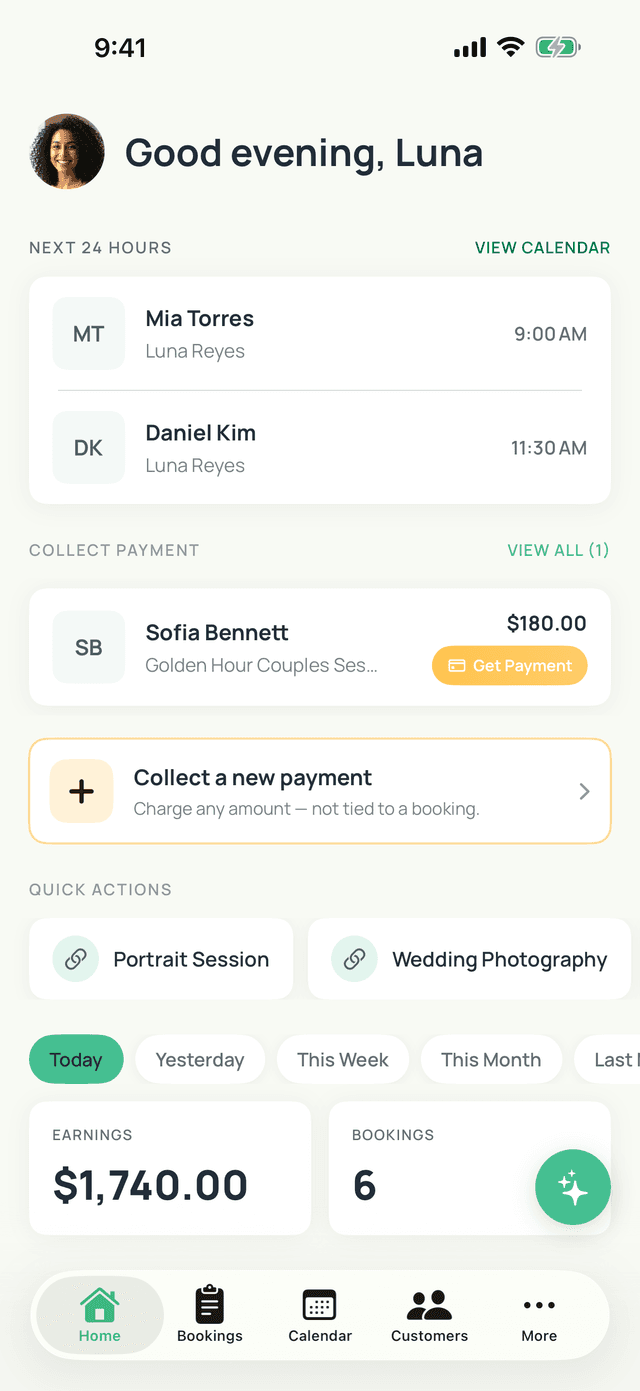
A booking page on your own domain, with payment in the same step. For a mini, a headshot or a family session from the menu, that is the whole of gate 6. For a wedding, it is the half that comes after the call, and the call can be booked the same way. The free plan takes the first hundred bookings without asking for a card.
- Your booking page, on your own domain or ours, that works as the link in your bio
- A mini, a family session and a headshot as separate services with their own length and price, and an extra location or extra retouched images as an add-on
- Payment at booking, or a card on file charged for the balance with the customer's permission, into your own Stripe account, or tapped on your iPhone at the session
- A consultation call as a service with a video link made for it, and a workshop with a seat count booked the same way


Nothing here is legal, tax or financial advice. Licensing, permits, insurance, sales tax and what a contract can hold you to all change with where you live and where you shoot, and for a photographer who travels those can be two different places. Only somebody who knows your jurisdiction can answer.