

How to start a car detailing business
Mobile or a shop: car detailing splits by where the car sits before it splits by anything else. Mobile is the customer's driveway, their tap and their outlet, a trunk and a bucket, and a premium for coming to them. A shop is rent, a lift and lighting before the first car, water you control, and a bay for the ceramic and correction work that wants one. Both run on the same machinery underneath: a date, a car, a price, a way to be paid. And nobody licenses a person to wash a car. The water has to go somewhere, though, and where it goes is the law.
Fourteen things come up when people set out to start a car detailing business. We measured how often each one gets asked about, then sorted them by something different: whether it actually stops money reaching you. Seven do. Seven can wait, whatever you have been told. Then we measured a fifteenth that nobody asks about at all, and left it on the chart as a control. Both lists are here, with the argument on each side and what each one costs.
Until these are done there is a specific reason the money cannot reach you, whether the car is parked in a driveway or in your bay. Each one is a yes or no question.
Some people call this procrastination. Others call it going to market. We try not to judge either way. None of them is what is stopping the money.
Measured in October 2026, United States, English. Autocomplete moves, so we re-measure whenever this page is updated.
Their driveway, or your bay?
The first decision in this trade is where the car sits while you work on it, and it sets your costs before it sets anything else. Mobile detailing happens on the customer's driveway, often with the customer's tap and outlet, and commonly carries a premium for coming to them. The water lands on their driveway, and the vehicle you arrive in needs insuring. A shop is rent, a lift and lighting before the first car, and in return the water is yours to control and the ceramic and paint-correction work gets the bay it wants. Underneath, it is the same job: a date, a car, a price, a way to be paid, and both end up booked the same way. You can end up doing both. This is about which one you start with.
Paste into Claude or ChatGPT. Fill the brackets.
I live in [CITY OR AREA]. I have [A CAR / A VAN / NO VEHICLE] and [AMOUNT] to start with, and I can work [DAYS AND HOURS]. List the questions I should answer before choosing between mobile detailing and renting a bay where I live, and for each one say which answer points toward mobile and which points toward a shop. Do not recommend one.
Check before you use it: If it picks one for you, ignore the pick. The useful part is the list of questions, and the answers to them are yours.
Is the price on the menu, or on the car?
The trade prices two ways at once, by the size of the vehicle and by its condition, and argues openly about which should be on the menu. Size is something a stranger can tell you when they book: a sedan, an SUV, a truck. Condition is not, and condition is what decides whether a full detail takes three hours or a whole day. Surcharges for pet hair, a smoker's interior and heavy soil are how menus survive that. Say it plainly to yourself before you publish a price: a beginner who prices from a menu and underestimates a filthy interior pays for it in hours.
Prices as published across the market, checked in October 2026. Mobile commonly carries a premium for coming to the customer. They disagree at the edges, and the spread is the answer: there is no going rate, only what your area carries and what you can say without flinching.
Paste into Claude or ChatGPT. Fill the brackets.
I want to charge [PRICE] for a full detail on a [SEDAN / SUV / TRUCK]. A detail like that takes me [HOURS], and I can do [N] a day, [N] days a week. Show me, with the arithmetic written out, what a month looks like at that price if [SHARE] of my slots sell, and again if every car takes two hours longer than I expected. Do not tell me what to charge.
Check before you use it: Check one line with a calculator. Arithmetic is where these tools sound most certain and are least reliable.
Are you allowed to do this here, and where does the water go?
Two things are regulated here, and neither of them is you. No US state licenses detailing as a trade. The first is the business: a general business license or registration from your city or county, a DBA if you trade under a name, and for a mobile business possibly a license where you work as well as where you are based, and in some cities a decal on each vehicle. The second is the water. Wash water carrying soap, chemicals or road grime may not go into a storm drain, and a mobile detailer working on somebody else's driveway is the one most likely to put it there. That belongs to the local stormwater program. Insurance comes in three pieces: general liability for the business, garage keepers for the customer's car, and commercial auto for whatever you drive to jobs.
Paste into Claude or ChatGPT. Fill the brackets.
I want to detail cars [MOBILE / IN A SHOP] based in [CITY, US STATE OR COUNTRY], working in [THE TOWNS I WOULD COVER]. Write me two separate lists of questions: one for the city or county clerk about registering and licensing the business, including whether I need a license in each town I work in, and one for the local stormwater program about where my wash water may go. Do not answer them. I want the question lists only.
Check before you use it: If it answers one of them with a yes, a no or a number, ignore that part. Those answers come from two different offices, and neither of those offices is an assistant.
Can the money actually reach you?
Near the bottom of the chart at 76, between licensing and the agreement, and an hour of setup decides whether a finished car has been paid for. Three kinds of job settle it three ways. A fleet or a dealer is invoiced on terms, and you carry the work until the money lands. A long job, a ceramic coating or a paint correction, commonly takes a deposit, because you are holding a day for it. A retail car is the open question: a card in the driveway, or a card on file. That is why the fork below is a decision about retail cars.
Paste into Claude or ChatGPT. Fill the brackets.
Write the payment terms for my detailing business as four short lines a customer reads once and understands: when payment is taken, whether a deposit applies and to which services, what happens if they cancel inside [NOTICE PERIOD] or the weather cancels for us, and whether I take tips. My terms are [YOUR TERMS]. Plain language, no legal phrasing, no clauses I did not give you.
Check before you use it: A notice period or a fee you did not type is one it invented. Both of those are decisions, and both of them are yours.
Is what a detail includes written down, and who pays for a scratch?
The quietest row on the chart at 62, which is the usual fate of paperwork, and much of what is there is people asking for waivers and contracts. In this trade the agreement is mostly the scope: what a full detail includes and what it does not, and what it means when a stain would not lift. Then the car itself, and the keys. A walk-around with photos before the keys change hands, and photos after, is what turns a scratch from an argument into a record. Agreements commonly say the detailer is not responsible for pre-existing damage and ask the customer to photograph and report it. And when the scratch is yours, garage keepers is the cover that pays. Ordinary liability does not.
Paste into Claude or ChatGPT. Fill the brackets.
Draft a one-page car detailing service agreement from my answers. Services and what each includes: [LIST]. What each does not include: [LIST]. Prices and surcharges: [PRICES]. Cancellation and weather: [TERMS]. Keys: [HOW I HANDLE THEM]. The walk-around and pre-existing damage: [YOUR TERMS]. Plain English a customer reads once. At the end, list every situation my answers do not cover.
Check before you use it: Any cap, fee or waiver wording in the draft that you did not give it is a decision it made for you. Strike it, or make it yours, and have a lawyer set up anything you mean as a waiver.
Can a stranger book you without sending photos first?
A wash or a standard detail can be booked from a menu. A sedan and an SUV can be two services, each with its own price and length, and a service area by ZIP stops a booking from a town you do not cover. A ceramic coating or a neglected interior is nearly always quoted after photos or a look. So this is the gate where online booking is the whole answer for the menu and half of it for the quote: once the price is agreed, the job still needs a date. The questions underneath are your customers' questions as much as yours. Answer them on the booking page and people stop messaging you to ask.
Paste into Claude or ChatGPT. Fill the brackets.
Write the service list for my car detailing booking page. I offer [SERVICES] at [PRICES], with separate prices for [SEDAN / SUV / TRUCK], in [AREA, ZIP OR POSTAL CODES]. Add-ons and surcharges: [LIST AND PRICES]. For each service, write a title and two sentences: what is included, and how long it usually takes. Somewhere on the page, answer these four: whether I need the customer's water and power, whether they need to be home, what happens when it rains, and whether I am insured. Under 400 words, no promises about results.
Check before you use it: Read it as somebody who has never had a car detailed. If they would still have to message you to find out how long it takes or whether you need their tap, the page is not finished.
Do the first ten come from driveways, or from one lot?
The last gate, because the other six exist to make this one possible. Nothing before it counts until somebody hands you keys. The row sits at 173, the second-loudest gate, and the trade's own version of the question is dealerships and fleets: people ask how to get detailing contracts with dealerships alongside how to get a first customer. A dealer or a fleet asks for proof of insurance and registration before the first car, pays a lower rate per car in exchange for the volume, and is invoiced on terms. A first dealer contract often comes from a customer who works at one. Driveways come one at a time.
Paste into Claude or ChatGPT. Fill the brackets.
Help me write one message to ten people who already know me. I detail cars [MOBILE / IN A SHOP] in [AREA], and I am looking for [N] first customers. My first free day is [DAY], and a [SERVICE] costs [PRICE]. Keep it human, keep it short, make it easy to say no, and ask them to think of one person whose car could use a detail, or who works at a dealership. Give me one version, not three.
Check before you use it: Read it back as if a friend had sent it to you. Whatever sounds like marketing is what stops it being answered.
Worth doing. Not what is stopping you.
Each of these is worth doing, and somebody who does this for a living will tell you it is essential. Somebody else, just as experienced, will call it what people do instead of asking ten people. None of them is the reason the money has not arrived yet.

262 on the chart as the equipment row, second only to price, and much of it is which polisher a beginner should buy. An extractor, a steamer, a second polisher, LED lighting: the full rig is what the first fifty cars pay for. The starter kit is on the gate list in the calculator below, $500 to $800, because nobody details with nothing. A water tank and a generator, $800 to $1,500, are the piece most people defer, and they move onto the gate list only on the day you decide to work driveways with no tap or outlet.
156 on the chart, and most of it is van setups and trailers. The $500 start is a trunk and a bucket. The insurance on whatever you drive to jobs is on the gate list; the van itself is not. A wrap is a sign that drives past people, and every version of it, from a magnet on the door to a full trailer, is easier to pay for once somebody has paid you.
201 on the chart, and car detailing business names is one of the trade's own searches. It is not the part anybody is deciding on when they hand you their keys. Content and social sit inside this item too, at 172. Before and after photos are the trade's marketing language, and posting them pays back over months if you keep at it, and not at all if you do it for three weeks. It is a legitimate channel, and it is not what produces a first booking.
136 on the chart, and nearly as many phrasings again named a city or a country, which is how territories are sold. Detailing franchises publish total initial investments of roughly $83,000 to $270,000, with a franchise fee of $30,000 to $50,000 inside that, and a royalty on gross sales that outlasts the fee. A mobile fleet-washing franchise runs $144,500 to $204,500. It is the biggest number on this page, bigger than opening a shop, and it is a decision about who you work for, not about whether you can start.
61 on the chart, the quietest row on either list, level with the service agreement. It is the thing every how-to-start page opens with, and the only item here a first customer never sees. Write one when somebody needs to read it, a lender, a landlord for a bay, or a partner. Until then, the seven gates above are the plan.
168 on the chart, with nearly as many again naming a city because people look for a class near them, and every one of those phrasings is the reader being the student: courses near me, classes, certification online free. The International Detailing Association sells a certified detailer program at roughly $150 to $299, with a $50 yearly renewal. No US state licenses detailing, so no certificate stands between you and a first car. Whatever a course is worth, nothing in it is what stops a first payment, and the fourteen things it would cover are on this page.
95 on the chart, inside the what-you-offer row, where the ceramic coating business phrasings sit. This is the classic stall in the trade: a brand's installer course before the first fifty washes, because learning feels like progress and asking feels like risk. It is also the one item on this list that turns into a gate. The coating brands require their own installer training before you may buy and apply their product, so the day you decide to sell coatings, it moves up the page. Until then, the first fifty cars are washes and full details, and they are what pays for the course.
What it costs to open
Start from the way you intend to work, then switch individual lines on and off. Every line is a range rather than a price, because not one of these costs the same thing in two places. Gate items are the seven that stop you being paid. Everything below the rule is the other seven.
Three ways to open, and the gap between them is not where people expect it. Mobile with the customer's water and power opens at $3,210 to $6,218, the cheapest way in. Going self-contained adds a tank and a generator and opens at $4,010 to $7,718. Both cost the same to keep open, $2,710 to $5,418 a year, and the biggest line on both is not a tool. It is commercial auto on the vehicle, $1,800 to $3,000 a year, more than the starter kit and the tank and generator put together. A shop opens at $1,410 to $3,218 and keeps open at $910 to $2,418 a year, which makes it look cheapest of the three. It looks that way only because rent has no number to show: a shop with rent, a lift and lighting is published at $50,000 and up. One line sits apart from all three: buying a franchise starts at $83,000.
- $500–$800one off
- $800–$1,500one off
- $0one off
- $600–$1,000a year
- $300–$1,300a year
- $1,800–$3,000a year
- $0a year
- $0one off
- $10a year
- $0–$108a year
- $0one off
- $0a month
- $0one off
- $0one off
- $150–$1,595one off
- $83,000–$270,000one off
Published prices in USD, checked in October 2026. Insurance, licensing and the rules about wash water all move with where you are, so no line here is your quote, only the shape of a cost. The lines showing zero have no single number to show: a registration priced by your own town, a water method priced by what you choose, an agreement you adapt yourself, a bay priced by where it is. They are listed so you do not forget them, not because they are free.
Gate 6 is the one we can just hand you.
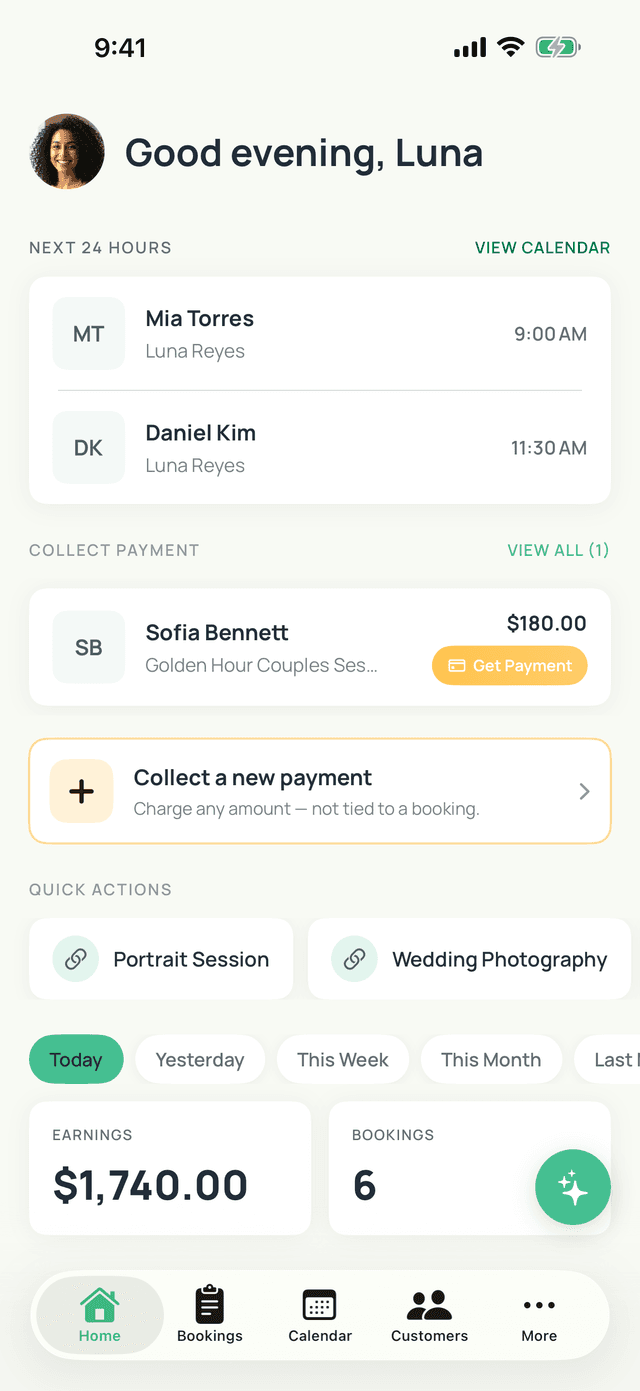
A booking page on your own domain, with payment in the same step. For a wash or a detail from the menu, that is the whole of gate 6. For a coating, it is the half that comes after the photos. The free plan takes the first hundred bookings without asking for a card.
- Your booking page, on your own domain or ours
- A sedan and an SUV as two services with their own length and price, and a coating or pet hair removal as an add-on
- Card at booking, or on file and charged when the keys come back with the customer's permission, into your own Stripe account, or tapped on your iPhone in the driveway
- A service area by ZIP, postal code or area name, so the wrong town cannot book


Nothing here is legal, tax or financial advice. Licensing, insurance and the rules about wash water all change with where you live and where you work, and for a mobile business those can be two different places. Only somebody who knows your jurisdiction can answer.